
How to calculate position size for stocks, futures and forex
By Flavio
Divide the money you're willing to lose by what one share, contract or lot loses at your stop, then round down. Here's the math worked out for a stock, an ES and MES futures trade and two forex pairs, and the shorter way on a Mac.
You found the trade: the entry is here, the stop is there. Now the order ticket asks for a quantity, and you want the number that loses a fixed amount if the stop is hit, not a round number that felt right.
The short answer: work out how much you’re willing to lose on this trade, work out how much one share (or contract, or lot) loses between the entry and the stop, divide the first by the second, and round down.
A calculator for your own numbers, not financial advice. The 1% in these examples is an example, not a suggestion. The prices are made up.
What’s the formula?
Two numbers, then a division:
- Risk budget = account × the risk you pick. With a $25,000 account and, for example, 1%, that’s $250.
- Risk per unit = what one unit loses if the price goes from the entry to the stop.
- Position size = risk budget ÷ risk per unit, rounded down to what your broker accepts.
Always down. Rounding up puts you over your budget.
The only part that changes between markets is the risk per unit:
| Market | One unit is | Risk per unit |
|---|---|---|
| Stocks | One share | Entry − stop |
| Futures | One contract | Ticks to the stop × tick value |
| Forex | One lot (100,000 units) | Pips to the stop × pip value per lot |
| Crypto | One coin | Entry − stop |
How do I calculate it for a stock?
Entry 50, stop 48.50, a long trade, on that $25,000 account at 1%.
- Risk per share: 50 − 48.50 = $1.50
- Size: $250 ÷ $1.50 = 166.67, rounded down to 166 shares
- Real risk: 166 × $1.50 = $249
- Position value: 166 × $50 = $8,300, about a third of the account
That’s it for stocks. The rounding is why you risk $249 and not $250.
How do I calculate it for futures?
A futures contract moves in ticks, the smallest price step, and each tick is worth a fixed amount of money. The E-mini S&P 500 (ES) moves in ticks of 0.25 points, and each tick is $12.50 a contract, so one point is $50. The Micro E-mini (MES) has the same 0.25 tick, worth $1.25.
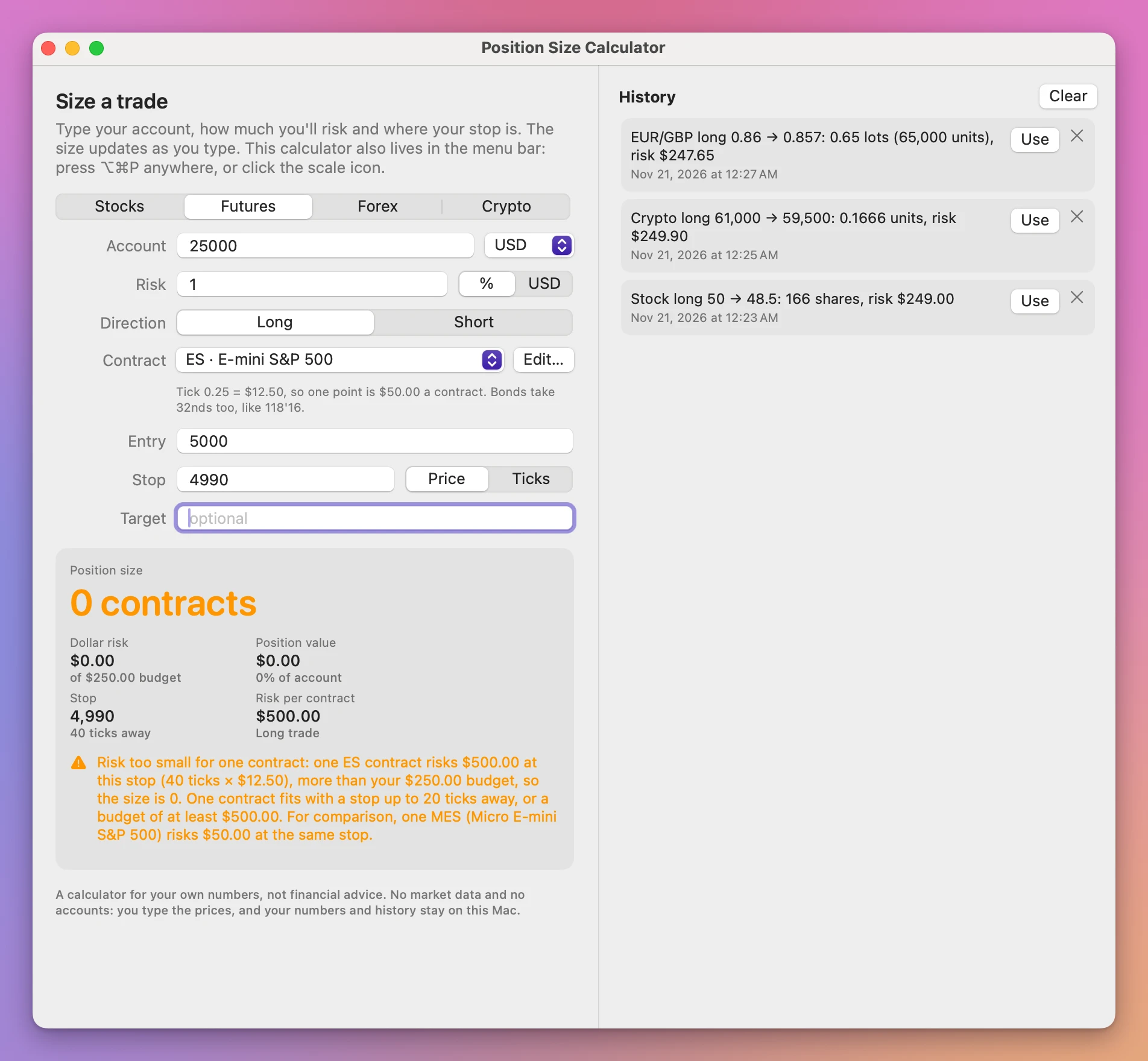
Entry 5000, stop 4990:
- Distance: 10 points, or 10 ÷ 0.25 = 40 ticks
- ES risk per contract: 40 × $12.50 = $500
- Size: $250 ÷ $500 = 0.5, rounded down to 0 contracts
Zero is the right answer. One ES contract at that stop loses twice your budget. Your choices are a closer stop (20 ticks would fit one contract), a bigger budget ($500), or a smaller contract:
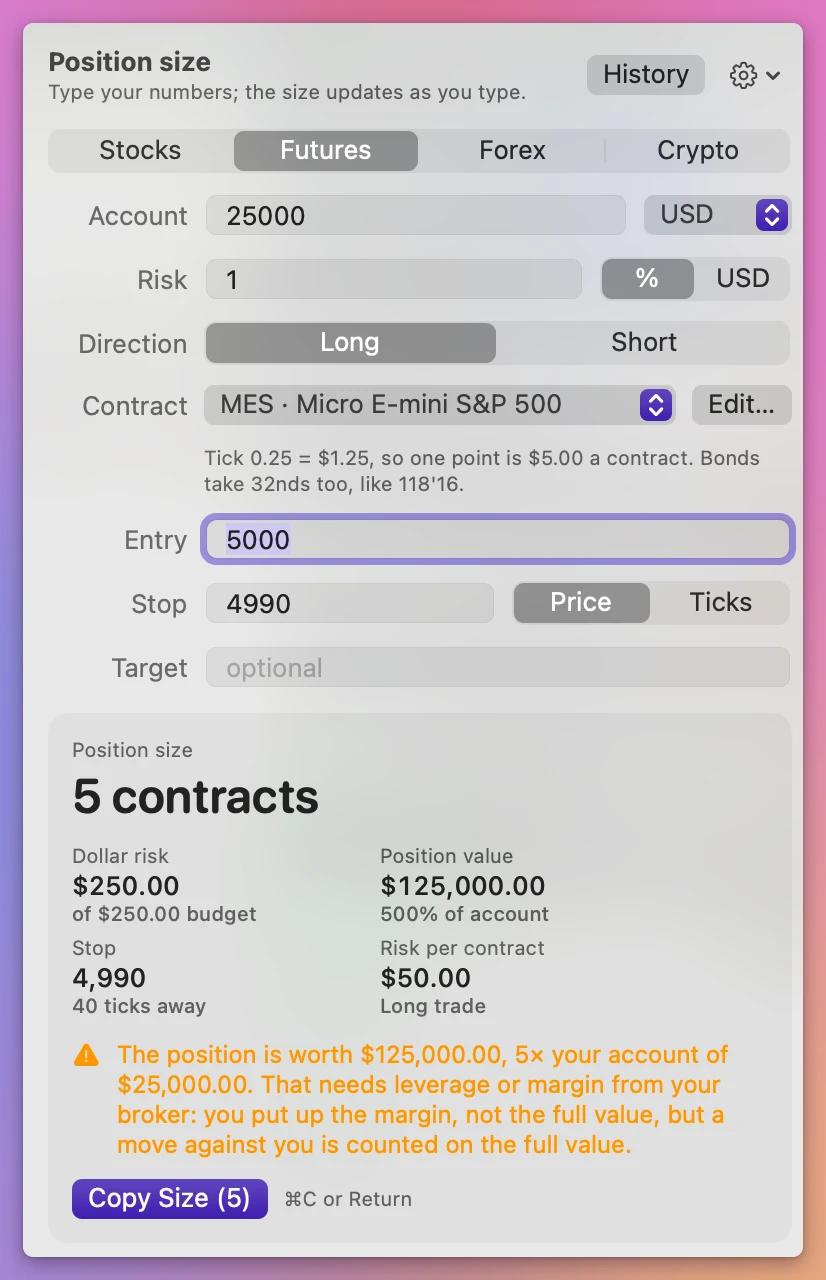
- MES risk per contract: 40 × $1.25 = $50
- Size: $250 ÷ $50 = 5 MES contracts, risking exactly $250
Notice how big those five contracts are: 5 × 5000 × $5 = $125,000 of exposure on a $25,000 account. Your broker asks for margin, not the full value, but the loss is counted on the full value.
How do I calculate it for forex?
A pip is the fourth decimal of most pairs (0.0001), or the second for pairs quoted in yen (0.01). A standard lot is 100,000 units of the first currency, a mini lot 10,000 and a micro lot 1,000.
On EUR/USD with a dollar account, one pip on a standard lot is 100,000 × 0.0001 = $10. Entry 1.0850, stop 1.0825:
- Distance: 25 pips
- Risk per lot: 25 × $10 = $250
- Size: $250 ÷ $250 = 1.00 lot
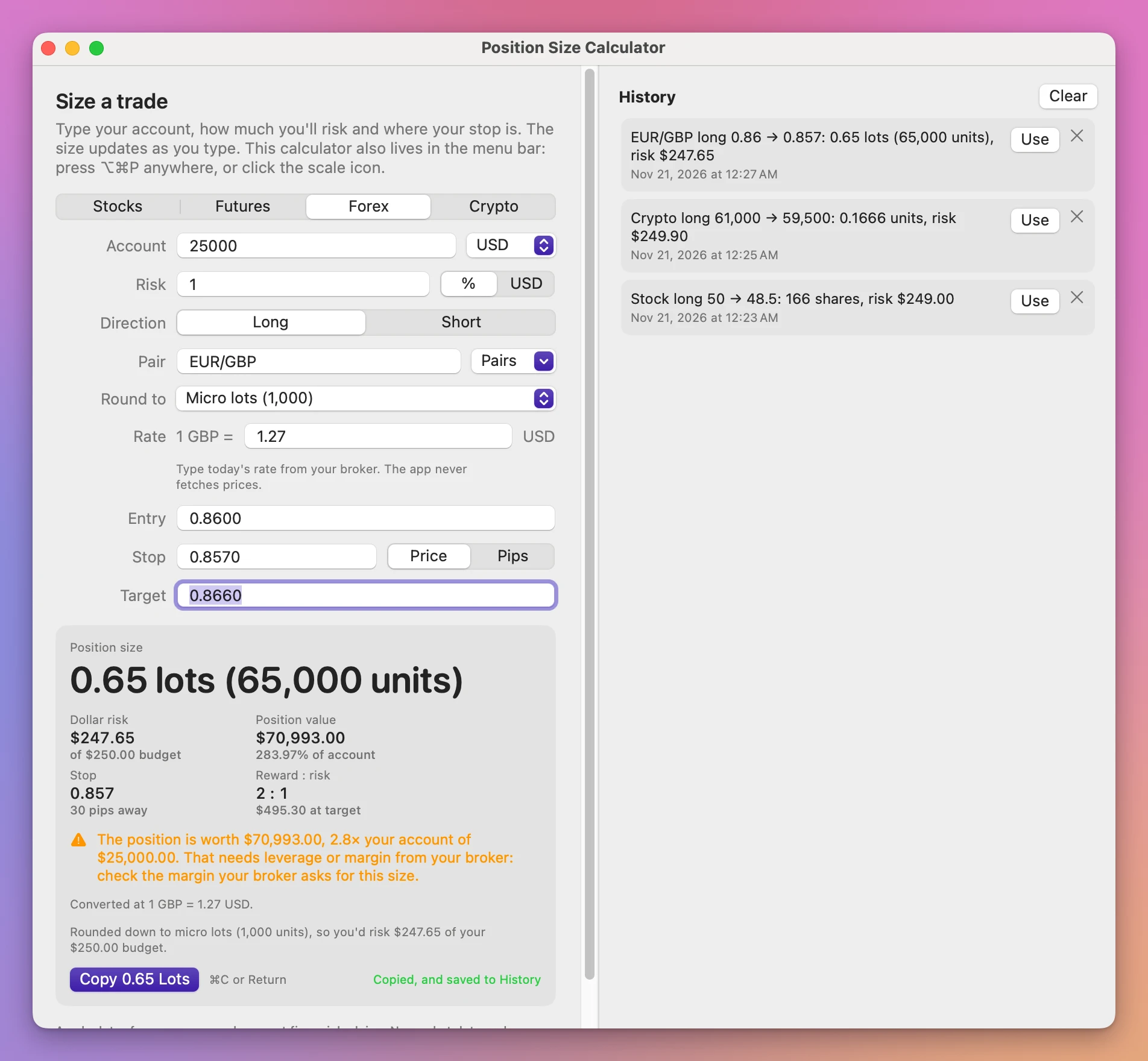
When the pair is quoted in another currency, convert the pip value first. On EUR/GBP a pip on a lot is £10, so with 1 GBP = 1.27 USD it’s $12.70. Entry 0.8600, stop 0.8570:
- Distance: 30 pips
- Risk per lot: 30 × $12.70 = $381
- Size: $250 ÷ $381 = 0.656 lots, rounded down to micro lots: 0.65 lots (65,000 units), risking $247.65
Crypto works like stocks, with the exchange’s step size instead of whole shares. Entry 60,000, stop 58,500 on a $250 budget gives 0.16666 coins, which is 0.1666 with a 0.0001 step.
Can I do it for free?
Yes, and for one market it’s quick.
- The Calculator app that comes with the Mac does the division. You still look up the tick value or pip value, convert the currency, and round to the right step yourself.
- A spreadsheet in Numbers or Excel can hold every formula above, with a table of tick values. You build it, keep it right, and keep the file open.
- Free web calculators, like the position size calculators on Babypips and Myfxbook, do the forex math for you. They’re free and work well. Each trade means going back to the browser tab and filling in the form again.
- Some broker platforms can size an order from a risk amount in the order ticket. If yours does, that’s the shortest way. Many tickets only show the order’s value.
Do it with Position Size Calculator
Position Size Calculator is a Mac app I made for this. It costs $19, paid once. It lives in the menu bar and opens from any app with Option-Command-P, with your account already filled in. The screenshots are from a test Mac with made-up prices.
Pick Stocks, Futures, Forex or Crypto, type the risk as % or an amount, then the Entry and the Stop. The size updates as you type. Here’s the stock trade from above:
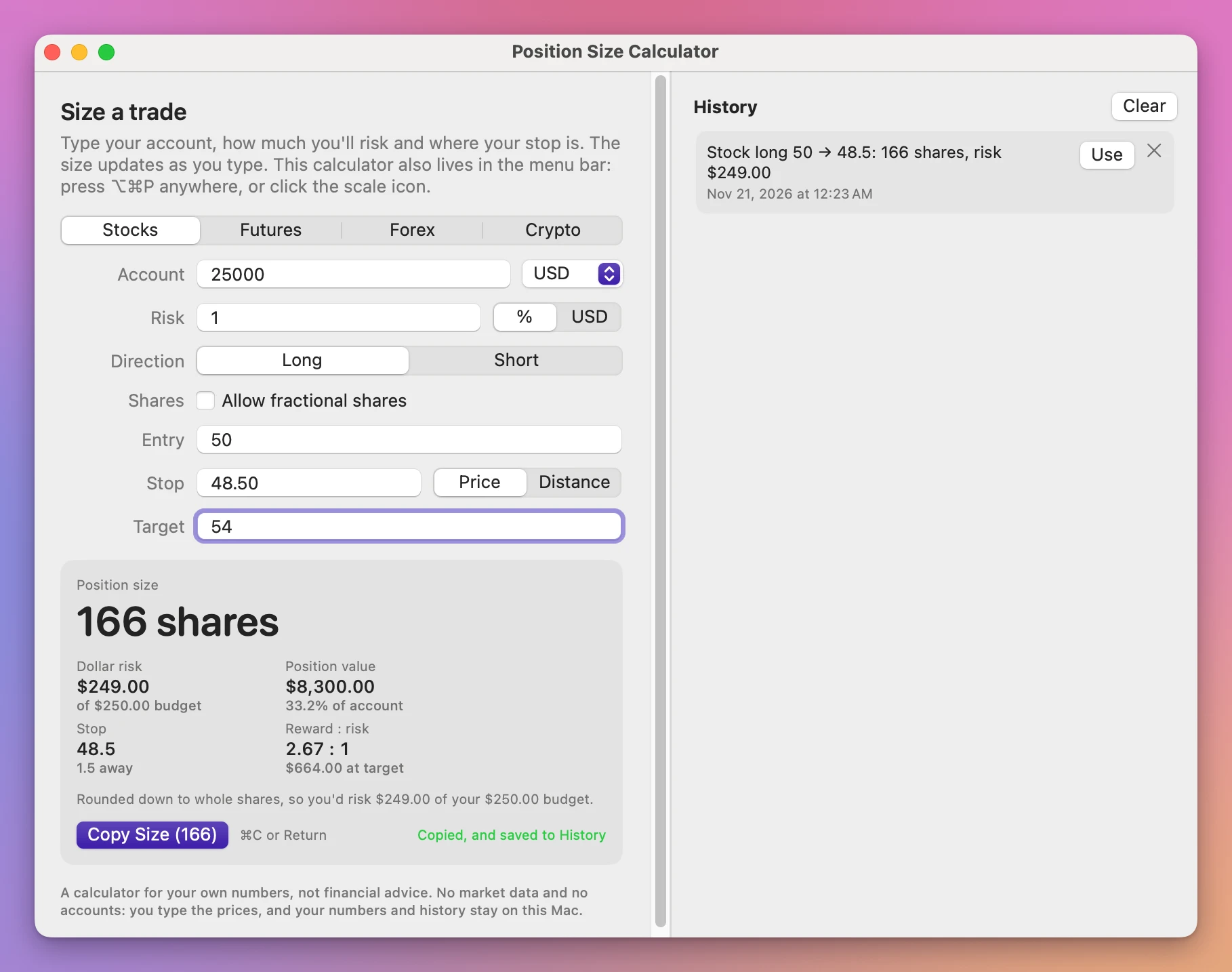
Press Command-C or Return and 166 is on the clipboard, with no unit after it, ready for the quantity field. The calculation goes into History, so you can fill the form with it again later.
For futures, pick the Contract. ES and MES are two of the 16 CME Group contracts built in, with their tick values. With the same 5000 and 4990, ES gives 0 contracts and a sentence that says why:
Switch the contract to MES and the menu bar calculator shows 5 contracts, with the orange warning about the $125,000 position:
For forex, type the pair and pick Round to micro, mini or standard lots. EUR/GBP on a dollar account brings up a Rate row, “1 GBP = [ ] USD”, where you type the rate from your broker. With 1.27 it shows the 0.65 lots worked out above, and the notes say what it converted and how it rounded.
Which way should you use?
| Calculator app | Spreadsheet | Web calculator | Position Size Calculator | |
|---|---|---|---|---|
| Cost | Free | Free | Free | $19, paid once |
| Tick and pip values | You look them up | You type them in once | Forex built in | Built in, plus your own contracts |
| Rounds to contracts, lots, steps | By hand | With formulas | Usually | Yes |
| Explains a size of 0 | No | No | Rarely | Yes, in a sentence |
| Opens from any app | No | No | Browser tab | Option-Command-P |
| Live prices | No | If you connect them | Some | No, you type them |
If you trade one stock market and the Calculator app takes you ten seconds, keep doing that. The app helps when you switch between stocks, futures and forex, and when you want the number on the clipboard without leaving the chart.
None of these ways include fees, commissions, slippage or spreads, and none knows your broker’s margin. The size is the loss at the stop if the order fills at your prices.
Get Position Size Calculator
Work out how many shares, contracts, lots or coins fit the risk you pick, for stocks, futures, forex and crypto, from the menu bar.
See Position Size Calculator → · Read the docs · $19. See the app page for tax details.
More trading and investing tutorials → · All app tutorials →