
Does the wash sale rule apply across different brokerage accounts?
By Flavio
Yes. The wash sale rule looks at purchases in all your accounts, your IRA and your spouse's included, but a broker's 1099-B only reports the ones inside the same account. Here's how to check across accounts.
You sold a fund at a loss in your taxable account at one broker. A few weeks later you, or your IRA’s dividend reinvestment, bought the same fund at another broker. Does that count as a wash sale?
Yes. The rule looks at purchases in every account you own, IRAs and a spouse’s account included. Your broker’s 1099-B only shows the wash sales it can see inside that one account, so a cross-account one won’t be on it.
This is about the US federal rule and the arithmetic, not tax advice. Your broker’s 1099 and a tax professional have the final word. The two accounts and every trade below are made up.
What the rule says
IRS Publication 550 defines a wash sale as selling stock or securities at a loss and, within 30 days before or after the sale, buying substantially identical stock or securities, acquiring an option to buy them, or acquiring substantially identical stock for your IRA or Roth IRA. A purchase by your spouse counts too.
Nothing in that list is about accounts. A purchase anywhere you or your spouse own shares can trigger it.
What happens to the loss depends on where the replacement was bought:
The IRA branch comes from Rev. Rul. 2008-5: the loss is disallowed, and the basis in the IRA isn’t increased.
Why your 1099-B doesn’t show it
Publication 550 says box 1g of Form 1099-B shows the wash sale loss disallowed only when the replacement had the same CUSIP and was bought in the same account. It also says you can’t deduct a wash sale loss even if the 1099-B doesn’t report it.
So for one taxable account at one broker, with no IRA or spouse buying the same thing, the 1099-B already does the job. Everything else is up to you.
The example: two accounts, one Schwab, one Fidelity
A taxable account at Schwab and a Roth IRA at Fidelity, exported as CSV files. These are the trades that matter:
| Date | Account | Trade |
|---|---|---|
| Jan 15, 2026 | Schwab | Buy 50 VOO at $540 |
| Sep 2, 2026 | Schwab | Buy 30 NVDA at $180 |
| Oct 14, 2026 | Schwab | Sell 30 NVDA at $150, a $900.03 loss |
| Oct 28, 2026 | Schwab | Buy 20 NVDA at $155 |
| Nov 12, 2026 | Schwab | Sell 50 VOO at $500, a $2,000.11 loss |
| Nov 25, 2026 | Fidelity Roth IRA | Buy 20 VOO at $505 |
| Dec 10, 2026 | Fidelity Roth IRA | Reinvest a dividend, 0.35 VOO |
Working it out by hand
The free way is to read both histories side by side and do the arithmetic.
NVDA is the easy one, because both trades are in the same account. 20 of the 30 shares were bought back 14 days later, so 20/30 of the $900.03 loss is disallowed: $600.02. It’s added to the new shares’ $3,100 cost, giving a basis of $3,700.02. The old shares were held 42 days, so the new ones count as held from Sep 16, 2026, 42 days before Oct 28. Going by Pub 550’s box 1g rule, this is the kind of wash sale Schwab’s 1099-B can report.
VOO is the one no 1099-B will show. The loss is $40.0022 a share. The IRA bought 20 shares 13 days after the sale, which washes $800.04, and the reinvested 0.35 shares wash another $14.00. That’s $814.04, and since both purchases are in a Roth IRA, it doesn’t move to any basis. $1,186.07 of the loss is left.
Together, $1,414.06 disallowed, $814.04 of it for good.
It’s doable for two trades. With a year of exports, it means lining up files with different layouts, matching lots first in, first out, splitting partial washes, and carrying basis and holding periods when a replacement is sold at a loss again. Counting the window wrong by one day (30 versus 31) changes the answer.
The faster way: Wash Sale Checker
Wash Sale Checker is a Mac app I built for this. It reads the CSV exports from several accounts together and finds the wash sales across them. It costs $19, paid once.
Add the files and mark the IRA
Click Add CSV Files… and pick both exports. The app recognized the Schwab and Fidelity layouts, counted 8 buys and 6 sales in the Schwab file, and skipped the dividend, transfer and total rows. Type an account name for each, and tick IRA or Roth IRA on the Fidelity one.
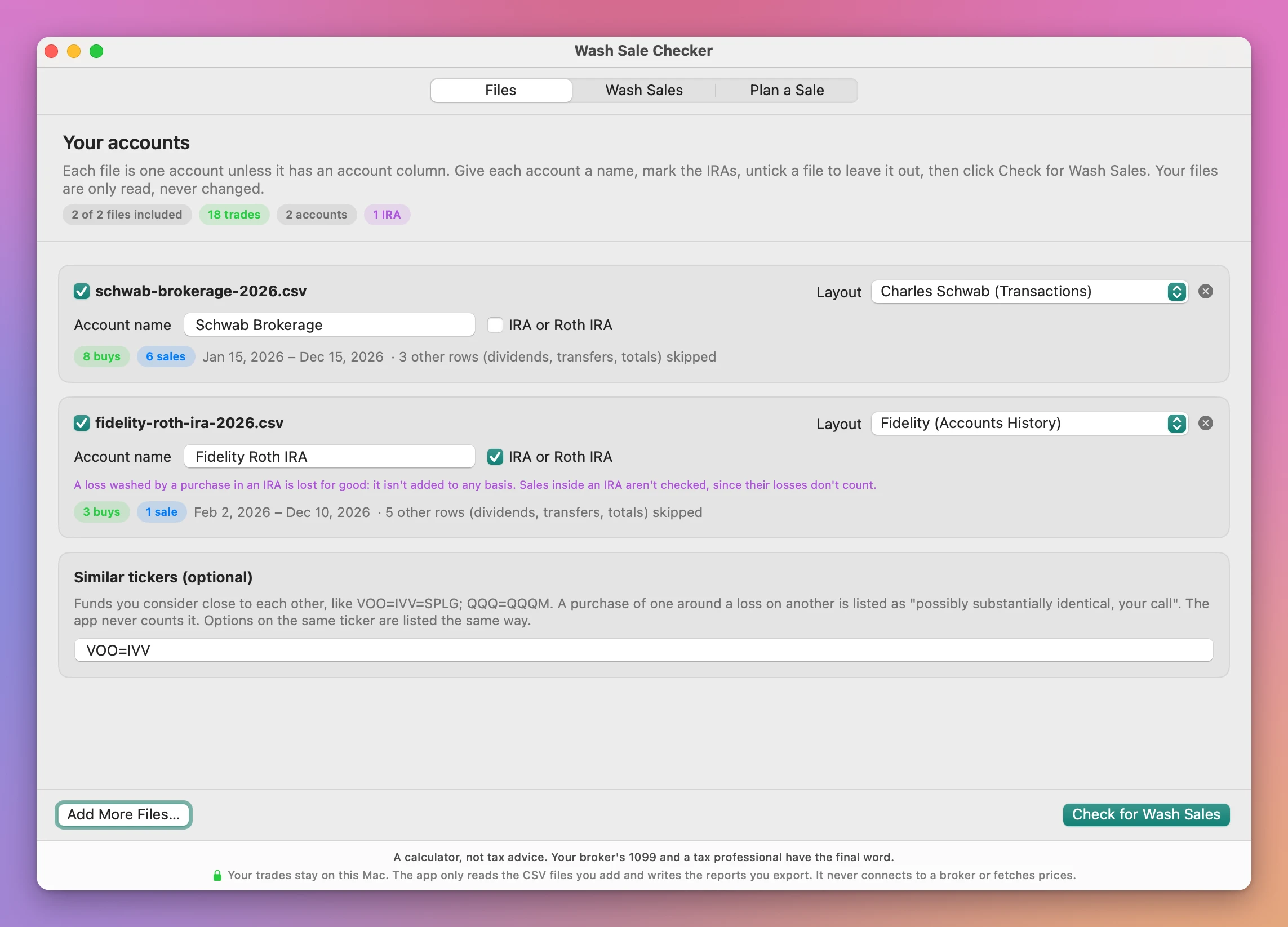
The Similar tickers field takes groups like VOO=IVV. Whether two different funds are substantially identical depends on the facts, so the app only flags those purchases as “your call” and never counts them.
Check for wash sales
Click Check for Wash Sales. The result matched the hand count: $1,414.06 disallowed, $814.04 lost for good through the IRA.
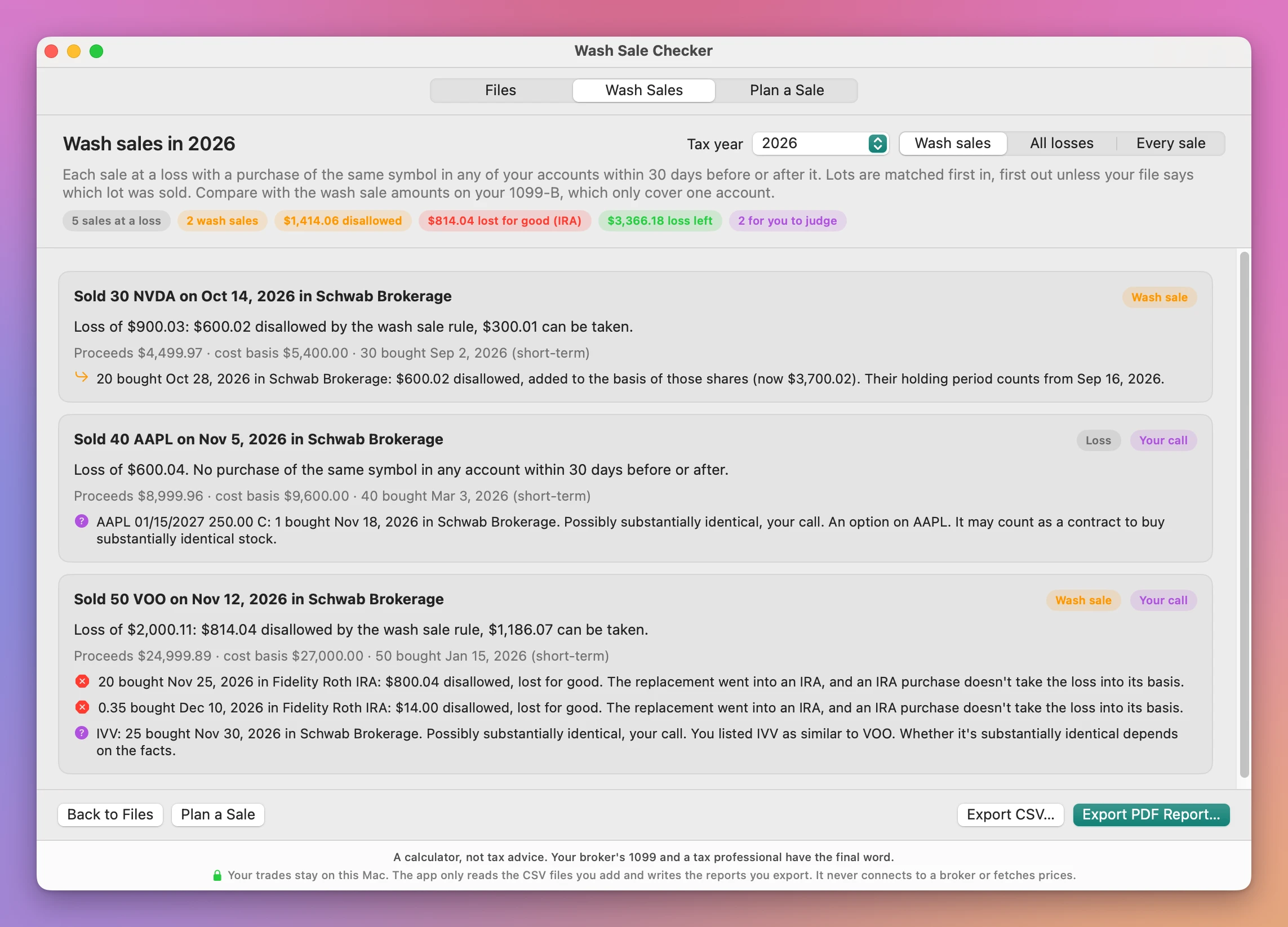
Each purchase that washed part of a loss is a line with the amount and where it went. An AAPL call bought 13 days after an AAPL sale at a loss shows up in purple, as an option that may count, for you to judge. Export PDF Report… saves the list as a PDF to put next to the 1099s.
Look up the window before a sale
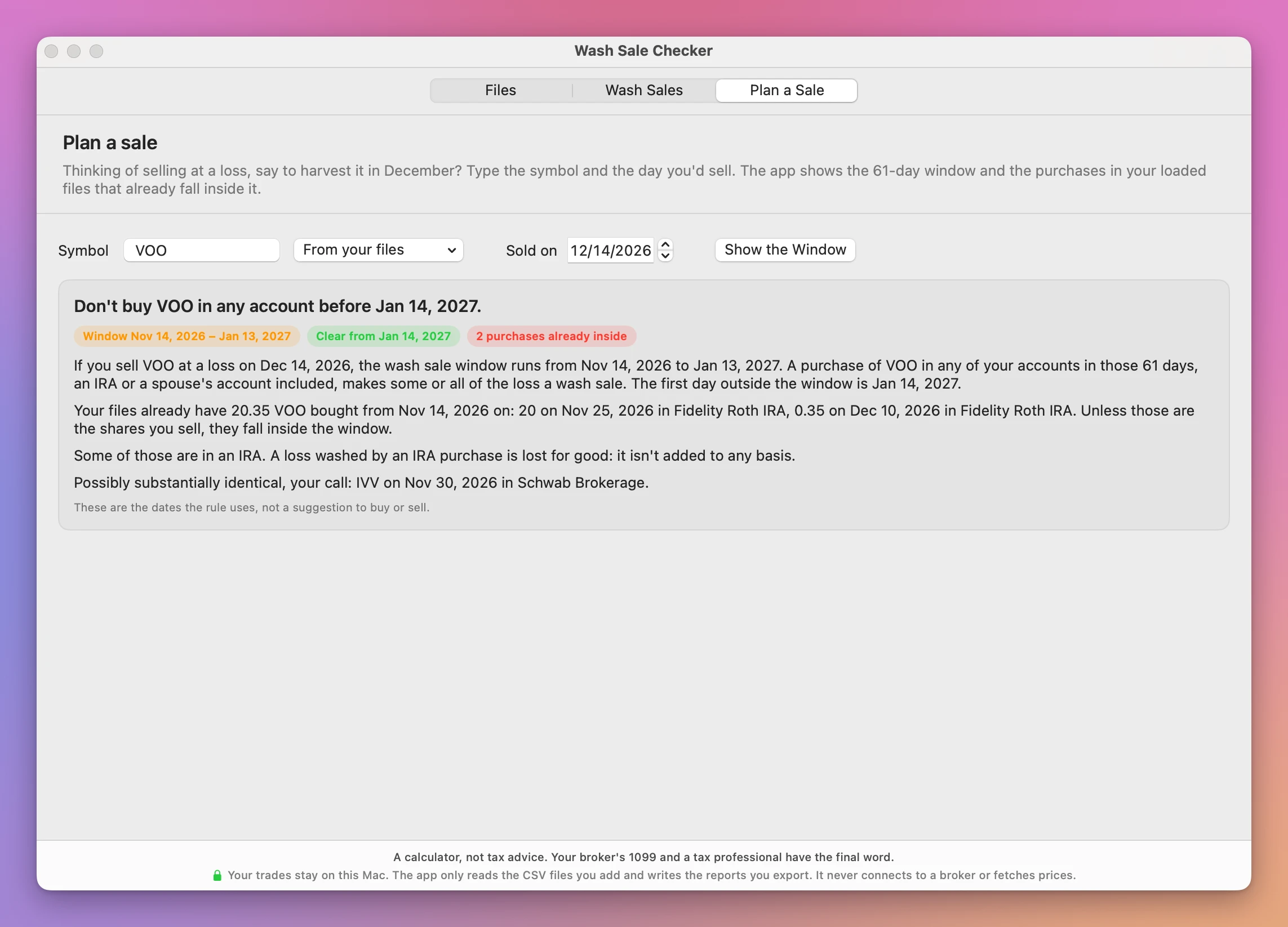
The Plan a Sale tab takes a symbol and a date. For VOO sold on Dec 14, 2026, it showed the window from Nov 14, 2026 to Jan 13, 2027, with Jan 14, 2027 as the first day outside it, and listed the two IRA purchases already inside.
The ways compared
| Broker 1099-B | By hand | Wash Sale Checker | |
|---|---|---|---|
| NVDA, same account | Reported | $600.02, worked out | $600.02 |
| VOO, bought back in the Roth IRA | Not reported | $814.04, worked out | $814.04, marked lost for good |
| New basis and holding period | Same account only | Worked out per lot | Shown on each line |
| A similar fund like IVV | Not reported | Your call | Flagged, your call |
| Window before a sale | No | Count the days | Plan a Sale |
The app has limits worth knowing. It matches the same ticker only, leaves out short sales, option expirations and assignments, doesn’t handle splits or other corporate actions, and doesn’t support average cost. The broker layouts were built from public descriptions of each export, and any CSV that doesn’t read right can have its columns matched by hand.
Get Wash Sale Checker
Load the trade history CSVs from all your brokerage accounts, IRAs included, and see every loss sale with a purchase of the same symbol within 30 days, with the loss that may be disallowed. A calculator, not tax advice.
See Wash Sale Checker → · Read the docs · $19. See the app page for tax details.
More trading and investing tutorials → · All app tutorials →