
An app by Flavio
Trading Session Clock
A menu bar clock that shows which markets are open, when sessions overlap and how long until the next open or close, in your time zone, with exchange holidays and early closes built in.
Buy Trading Session Clock · $19One-time purchase. Plus tax where it applies.
macOS 14 or later · Apple silicon and Intel
Latest version 1.0.1, released November 22, 2026
You trade from Rome, and the New York open is at 15:30. Except for three weeks in March, when the US has moved its clocks and Europe hasn’t yet, and it’s at 14:30. And the Friday after Thanksgiving, when the NYSE closes at 13:00 New York time. And the day the London Stock Exchange is shut for a bank holiday that nobody in New York has heard of.
A world clock tells you the time in New York, and leaves you to work out whether the market there is open.
Trading Session Clock lives in your menu bar and does that part. It reads like “NYSE opens in 20m” or “London closes in 14m”. Click it and you see every market you follow on one 24-hour bar of your own day, where they overlap, and a countdown to each open and close, with each exchange’s holidays and early closes already in.
Who it’s for
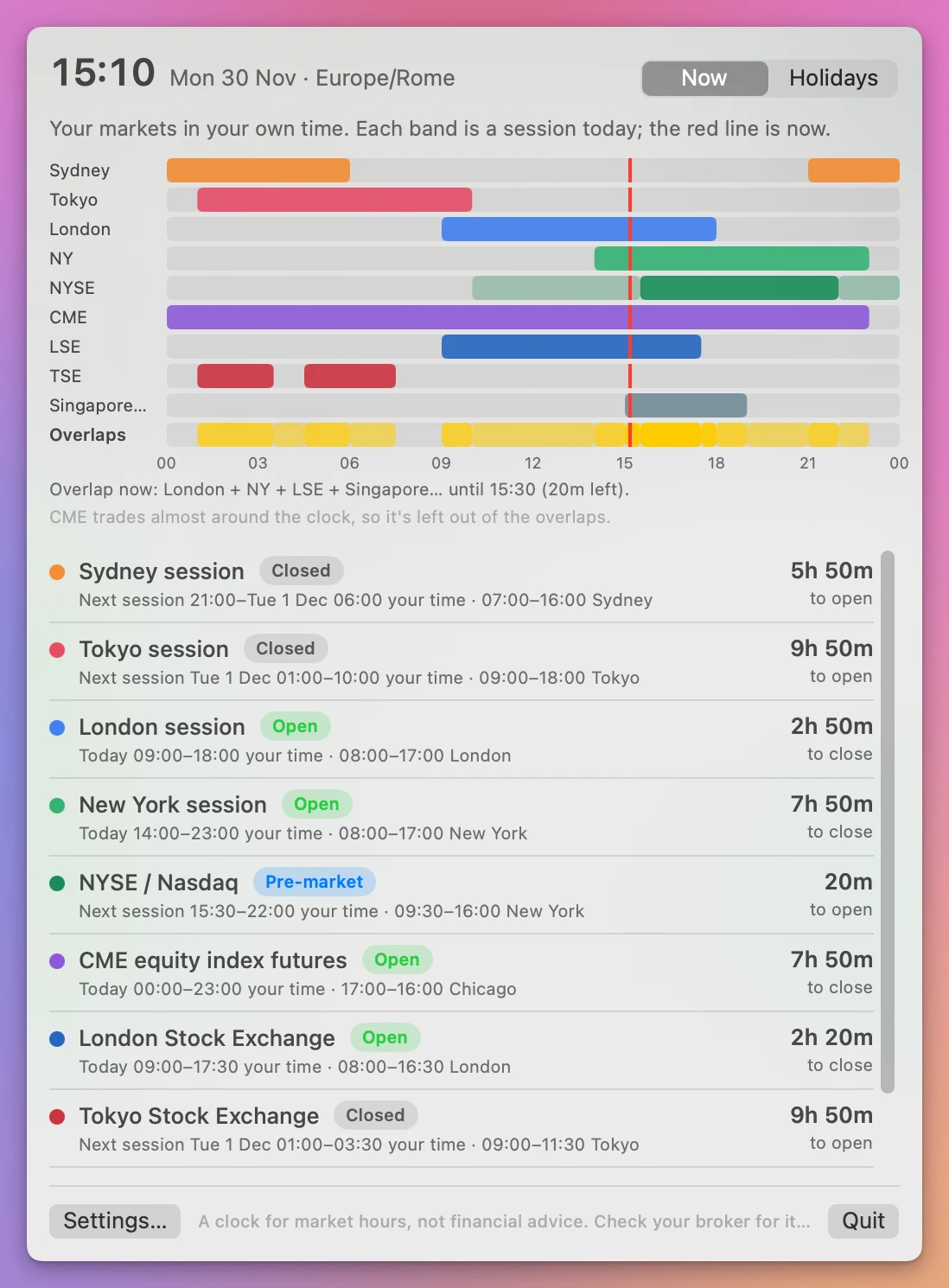
- Forex traders in Europe or Asia. You want to see at a glance when London and New York overlap, without converting the times again every morning, and the bar shows it as a yellow band with “until 15:30 (20m left)”.
- Futures traders on ES or NQ outside the US. You keep forgetting the Sunday 17:00 Chicago open, the daily break from 16:00 to 17:00, and the early halts on US holidays, like 12:15 Chicago time on the Friday after Thanksgiving.
- People in Australia or Asia who trade US stocks. You want a ping 10 minutes before the NYSE opens, with pre-market shown, and you’ve been caught before by the 13:00 close the day after Thanksgiving.
- Traders who follow Tokyo or Hong Kong. You need the lunch breaks and the Asian holidays, like Golden Week and the Lunar New Year half days, in your own time. The menu bar says “TSE lunch · reopens in 45m”.
- Anyone who plans around the daylight saving gap weeks. In March and October/November the US and Europe change clocks on different dates, and the London/New York overlap runs three hours instead of two. The app uses real time zones, so it moves with them.
From install to a clock in the menu bar
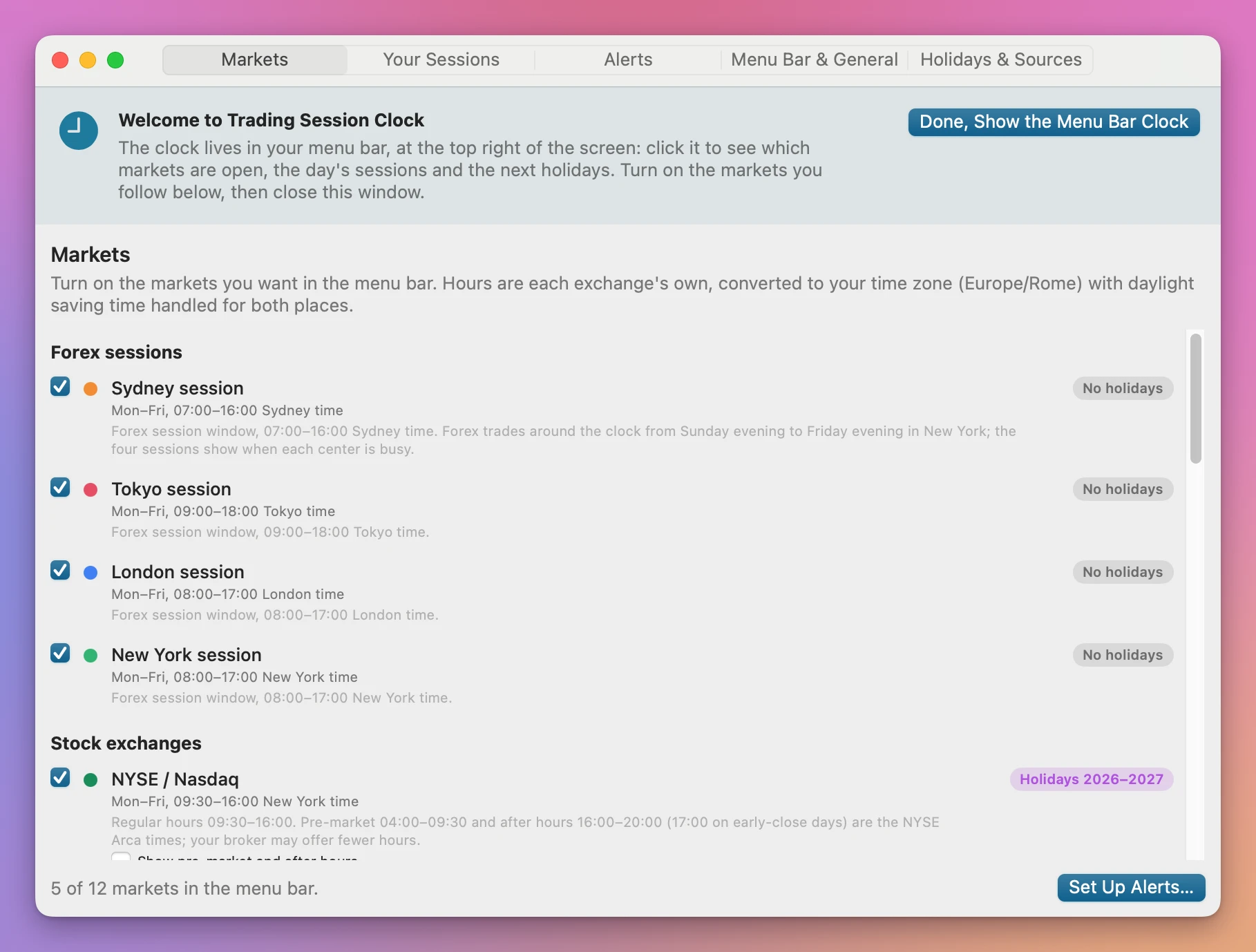
- Open the app. It has no Dock icon. A welcome window opens on the Markets tab and says the clock lives in the menu bar.
- Turn on your markets. Each one has a checkbox, its days and hours, today’s hours in your time, and a pill that says which years of holidays it covers. The four forex sessions and NYSE / Nasdaq are on to start with. NYSE / Nasdaq has Show pre-market and after hours.
- Click Done, Show the Menu Bar Clock. The status shows up at the top right of the screen.
- Click the clock. The Now tab shows the 24-hour bar, the overlaps and a row per market. The Holidays tab lists the holidays and early closes in the next 60 days for the markets you follow.
- Set up alerts if you want them. Click Settings…, then Alerts. For each market pick Before open, Before close or both, how many minutes before (0 to 120, in steps of 5), and Notification, Sound or both. Send a Test Alert checks that notifications reach you.
- Turn on Launch at login in Menu Bar & General, so the clock and the alerts are there after a restart.
What you get
Sessions, not city times
Each market row has a status pill: Open, Open · early close, Lunch break, Pre-market, After hours, Holiday or Closed. Next to it is today’s session (or the next one) in your time and in the exchange’s time, and a countdown to the close or the open.
The built-in markets are the Sydney, Tokyo, London and New York forex sessions, NYSE / Nasdaq, CME equity index futures, the London Stock Exchange, Xetra (Frankfurt), Euronext Paris, the Tokyo Stock Exchange, the Hong Kong Exchange and the Australian Securities Exchange. Tokyo and Hong Kong have their lunch breaks, and CME has its Sunday open and daily break.
Overlaps on one bar
The Now tab draws your local day from 00 to 00, one lane per market. Regular sessions are solid, pre-market and after hours are pale, and a red line marks now. The Overlaps lane is yellow, darker where more markets overlap, and a sentence names the overlap you’re in or the next one. CME is left out of the overlaps, because a 23-hour session overlaps everything, and the popover says so.
Holidays and early closes
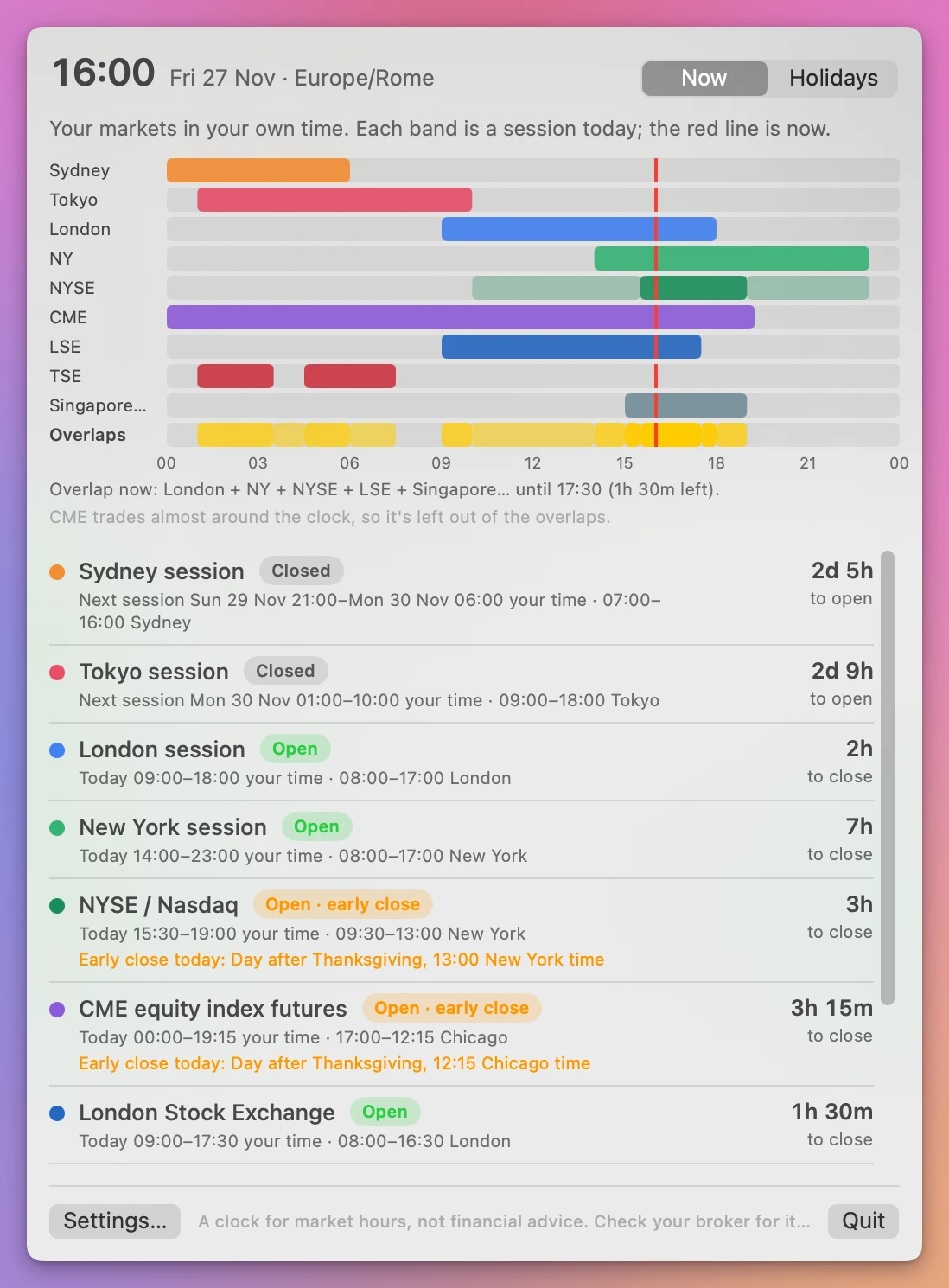
On the day after Thanksgiving, the NYSE row says Open · early close and “Early close today: Day after Thanksgiving, 13:00 New York time”. CME’s row says 12:15 Chicago time.
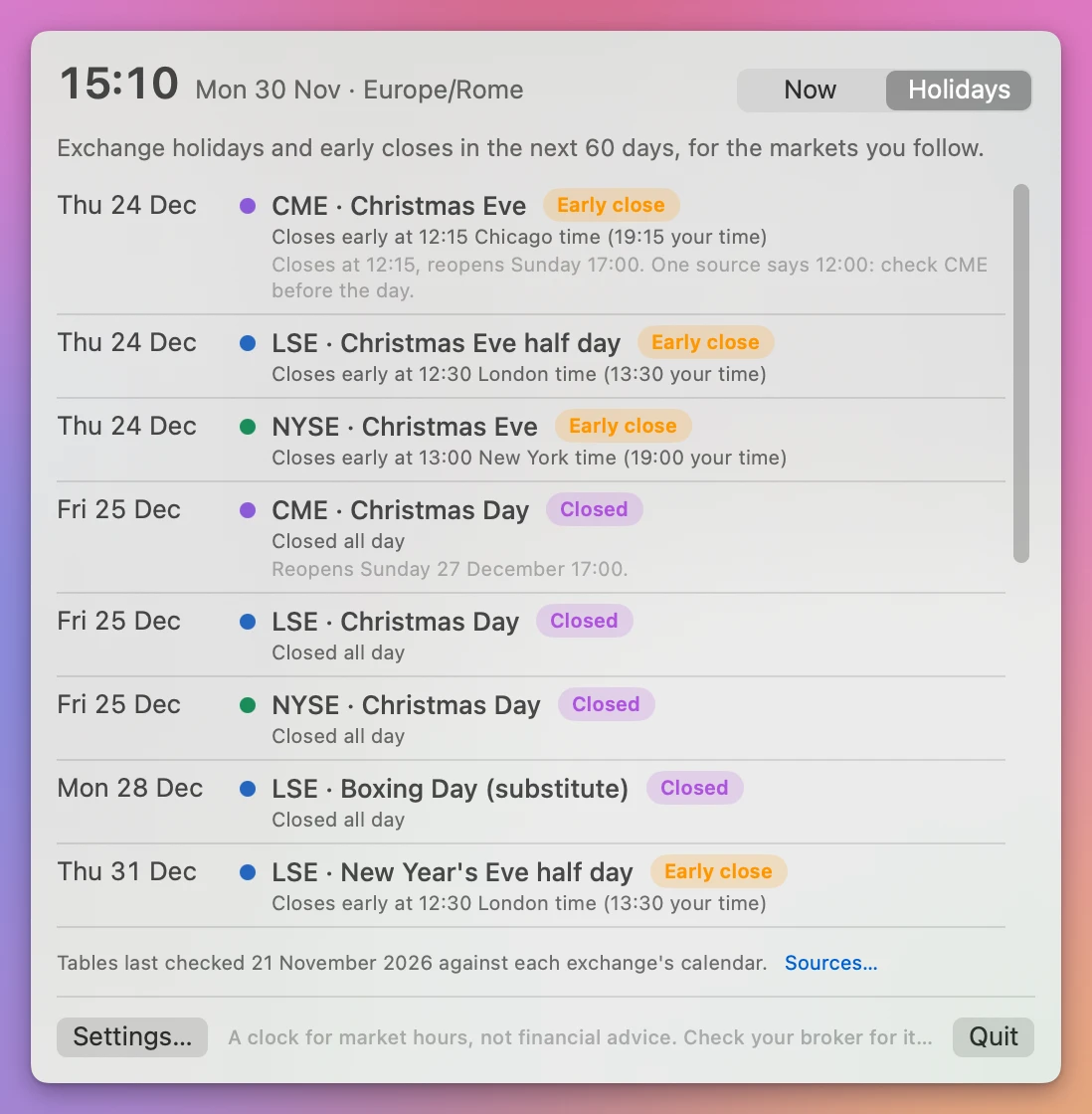
The Holidays tab in the popover lists what’s coming in the next 60 days, with the close time in the exchange’s time and yours: “Closes early at 13:00 New York time (19:00 your time)”.
Where the holiday dates come from
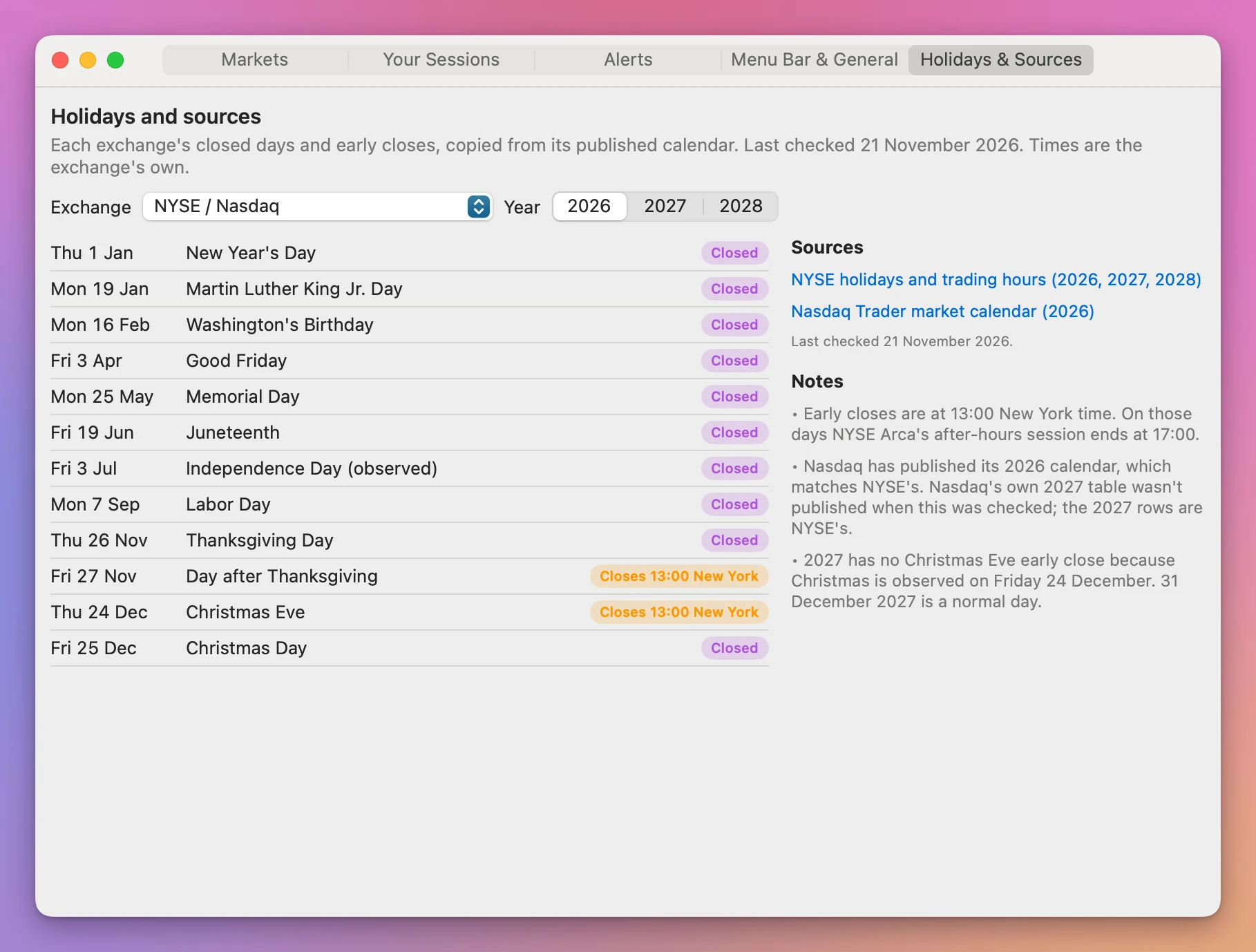
The holiday tables cover 2026 and 2027. Holidays & Sources in Settings shows each exchange’s table by year, the links it was copied from, the date the tables were last checked (21 November 2026) and notes on anything uncertain. A few early closes weren’t published yet when the tables were made, like the Euronext half-day times and Xetra’s 30 December 2027 close, and the notes say so. For 2028 the app says it doesn’t have the table, so you don’t get a guess.
Your own sessions
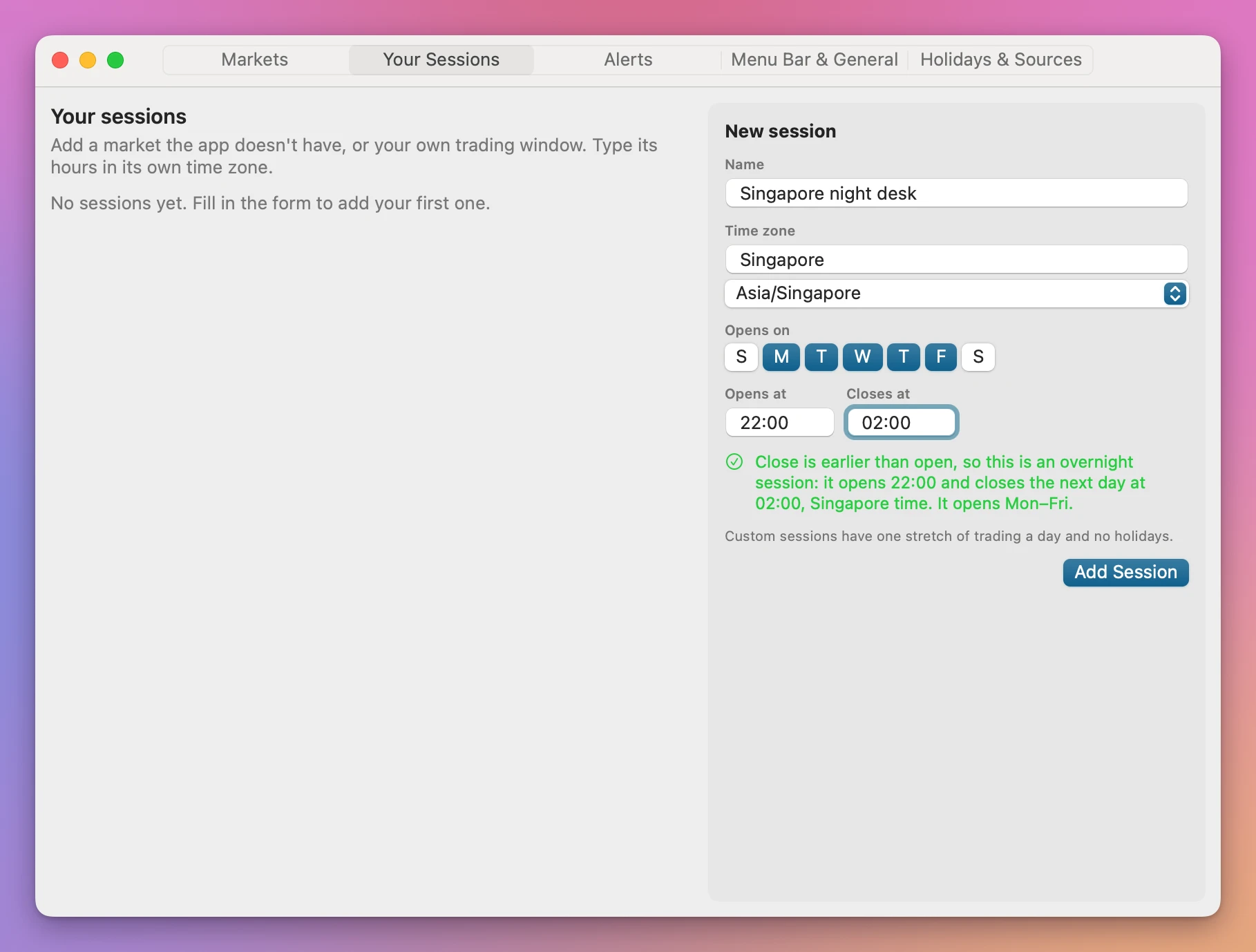
In Your Sessions you can add a market the app doesn’t have, or your own trading window: a name, a time zone (with a search field), the days, and Opens at and Closes at. A sentence under the form tells you what you typed. A close earlier than the open is an overnight session, and the sentence says it closes the next day. If the open and close are the same, or the name or days are missing, it tells you in orange and Add Session waits.
A menu bar that says what you need
In Menu Bar & General, pick what the clock shows: whichever market opens or closes next, or one market. The styles are Status and countdown (“NYSE open · 2h 14m to close”), Short countdown (“NYSE ▼2h 14m”) and Icon only, with a live preview of what it reads right now.
The app also comes with a command line tool inside it, which gives the same answers (what’s open now, the next open or close, the holiday tables) for scripts.
Why not use the World Clock
macOS already has world clocks, in the Clock app and as a widget. They’re free and they handle daylight saving. They show the time in a city, so you still have to know that the NYSE opens at 9:30 New York time and work out what that is for you. They know nothing about lunch breaks, CME’s Sunday open and daily break, early closes or exchange holidays.
Free market-hours websites, like the forex session clocks, do show sessions and overlaps. They live in a browser tab, some use fixed offsets that are an hour off during the daylight saving gap weeks, and many skip early closes and exchange-specific holidays. You can’t add your own session or get an alert.
TradingView and broker platforms show the session of the chart or the instrument you’re looking at, inside the platform. That’s the right place when you’re trading that instrument. It isn’t a glance across Tokyo, London and New York while you’re doing something else.
Holiday calendars you subscribe to can list the closures. They don’t show an early close in your time, or whether a market is open right now.
| World Clock / widget | Market-hours website | Trading Session Clock | |
|---|---|---|---|
| Time in another city | Yes | Yes | Yes |
| Market open or closed now | No | Yes | Yes, in the menu bar |
| Lunch breaks (Tokyo, Hong Kong) | No | Sometimes | Yes |
| Exchange holidays and early closes | No | Often missing | 2026 and 2027 tables, with sources |
| Daylight saving gap weeks | Yes | Depends on the site | Yes, real time zones |
| Alerts before an open or close | No | No | Yes, while the app runs |
| Your own sessions | No | No | Yes |
| Where it lives | Widget or app | A browser tab | Menu bar, offline |
What it doesn’t do
- It isn’t advice. It’s a clock for market hours, not financial advice. Check your broker for its own hours.
- It has no live data. It can’t know about unscheduled halts, a typhoon closure in Hong Kong or your broker’s own hours. There are no prices.
- Forex sessions have no holidays. They use the usual windows (Sydney 07–16, Tokyo 09–18, London 08–17 and New York 08–17, each in local time). Your own sessions have one stretch a day and no holidays.
- Pre-market and after hours are NYSE Arca’s times (04:00–09:30 and 16:00–20:00 New York time, after hours to 17:00 on early-close days). Brokers differ.
- Alerts fire only while the app runs. If the Mac was asleep at the moment of an alert, that alert is skipped, not sent late.
- The holiday tables stop at 2027. An update will add the next year when the exchanges publish it.
Questions
Where do the holiday dates come from?
From each exchange’s published calendar, except CME, whose own site couldn’t be read automatically. CME’s times come from broker copies of its calendar, and the app says so in its notes. The Holidays & Sources tab lists every source and the date the tables were last checked. Before trading a holiday, check the exchange.
Does it handle daylight saving time?
Yes. It uses each exchange’s real time zone and yours, so in the weeks when the US and Europe are an hour off, the sessions and overlaps move with them.
Does it go online?
Only to check for its own updates. Your settings stay on your Mac, in a JSON file in Application Support. There’s no market data feed.
Where is the app after I open it?
In the menu bar, at the top right of the screen. It has no Dock icon. Click the clock, then Settings… to change the markets, sessions and alerts.
What it needs
Trading Session Clock runs on macOS 14 Sonoma or later, on Apple silicon and Intel Macs.
The Trading Session Clock guide walks through each setting.
Buy Trading Session Clock
$19 plus tax where it applies, paid once.
Download the app from the order page or your Creem receipt, unzip it and move it to Applications. I sign the app with my Apple Developer ID, and Apple notarizes the download.
The app checks for updates once a day. When a new version is ready, click Install and Relaunch. To check anytime, open Settings… and choose Trading Session Clock → Check for Updates… from the menu bar.