Electronic components: Resistors
By Flavio Copes
An introduction to resistors in electronics: how they limit current, how color bands encode the resistance value, and the difference from variable resistors.
A resistor is a conductor component that has a certain amount of resistance. We use it to limit the amount of current flowing in a circuit, or to drop a voltage to a level another component can handle.
Resistance is measured in ohms, with the Ω symbol.
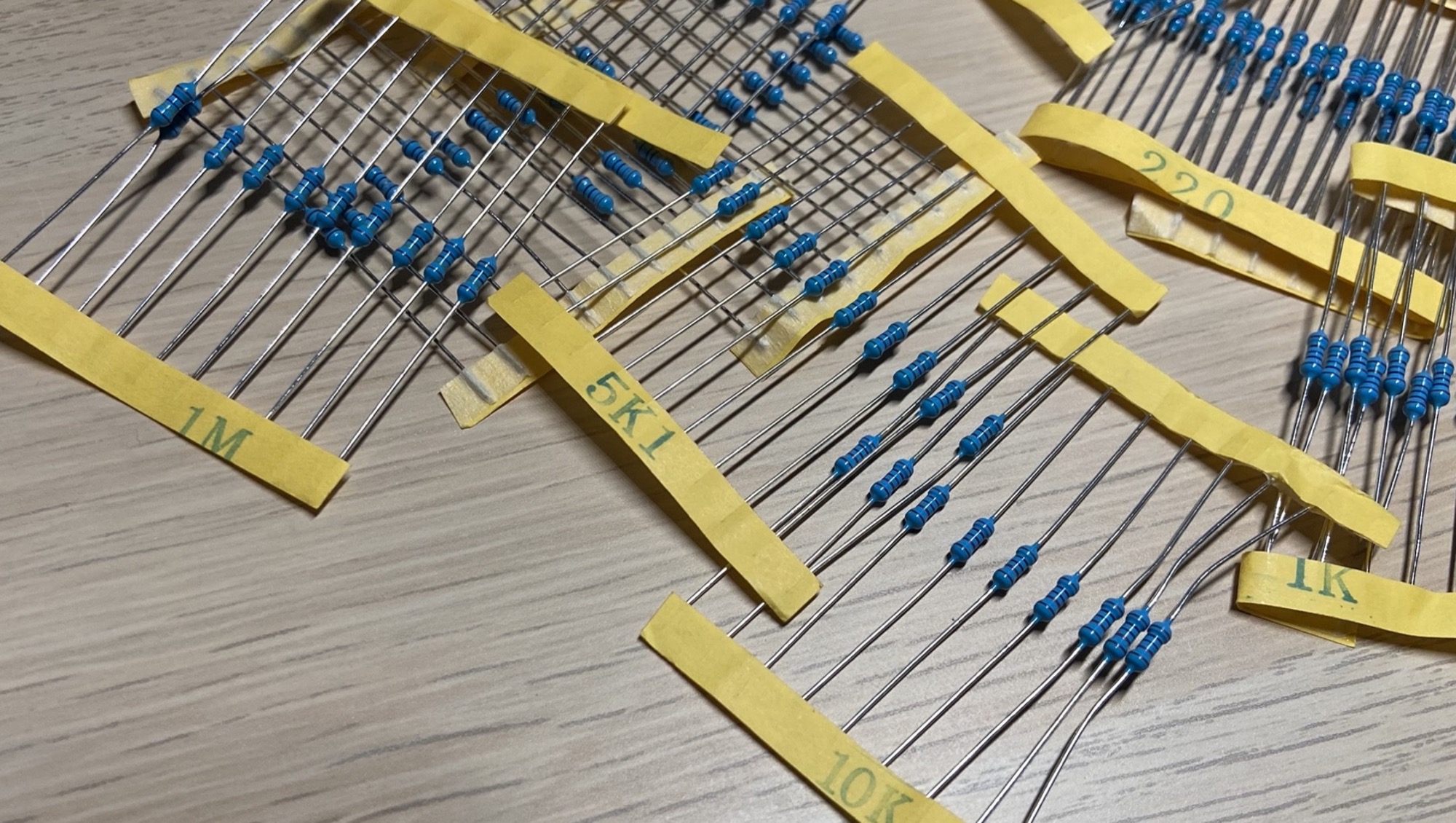
We have a lot of different resistors, built with various materials, and with different resistance values. For example in my set I currently have:
- 10Ω
- 220Ω
- 330Ω
- 1kΩ
- 2kΩ
- 5kΩ
- 10kΩ
- 100kΩ
- 1MΩ
Why do we need resistors?
The answer is Ohm’s law: V = I × R. Voltage equals current times resistance.
Rearranged, I = V / R. For a given voltage, more resistance means less current.
Take an LED connected to a 5V supply. A typical red LED drops about 2V and wants around 10mA of current. The resistor has to absorb the remaining 3V.
R = 3V / 0.01A = 300Ω. You won’t typically find 300Ω in a hobby kit, so we pick the closest common value above it: 330Ω. That’s why 330Ω shows up in so many LED circuits.
Without that resistor, the LED would draw far more current than it can handle, and it would burn out. Often instantly.
How to read the resistance value
Each value has a different color combination on the resistor body, so we can identify the resistance value.
On common 4-band resistors, the first two bands are digits, the third is the multiplier, and the fourth is the tolerance. Gold means 5% tolerance, so a 330Ω resistor can measure anywhere between 313Ω and 347Ω.
Reading the colors is a skill on its own, and there are online calculators that help you with that, like this one.
A pitfall: the value is only half the story. Resistors also have a power rating, and the common ones in hobby kits handle 1/4W. Power is P = V × I. If the resistor has to dissipate more than its rating, it overheats. The fix is a resistor with a higher power rating, or a circuit that drops less power across it.
Fixed and variable resistors
Those above are fixed resistors, with a fixed resistance value.
Some other resistors which we’ll see later can let the users change their resistance (potentiometers), some change their resistance depending on the temperature (thermistors), light (photoresistors), and so on.
We’ve seen how a resistor can limit the amount of current flowing in a circuit in the post with the LED and the battery circuit.
Want me to talk about your product? You can sponsor this site.
Related posts about electronics: