Ubuntu's slow kernel patches, and the model behind them
By Flavio
Tagged: Security
Ubuntu took weeks to patch remote kernel bugs Debian fixed in days. Freeze-and-backport worked when bugs were rare. We need a different approach.
On November 25, security researcher Hanno Böck wrote to the oss-security list about slow Ubuntu security response times. NoisyTCP (CVE-2026-99288), a remote memory corruption in the kernel’s TCP stack, had been public for nine days, and Ubuntu still had no fix. Other distros had one ready on the day the details came out.
The post reached the top of Hacker News, and the thread is full of people moving their server images from Ubuntu to Debian.
It’s the second time this month. In early November I wrote about CVE-2026-98432, the IPv4 TCP use-after-free, while Ubuntu was the one major distro still listing it as vulnerable, and then about moving a Droplet from Ubuntu to Debian for people who didn’t want to wait.
This is Ubuntu’s tracker for NoisyTCP. Every supported release of the main linux package says “Vulnerable”, with a fix “work in progress”:
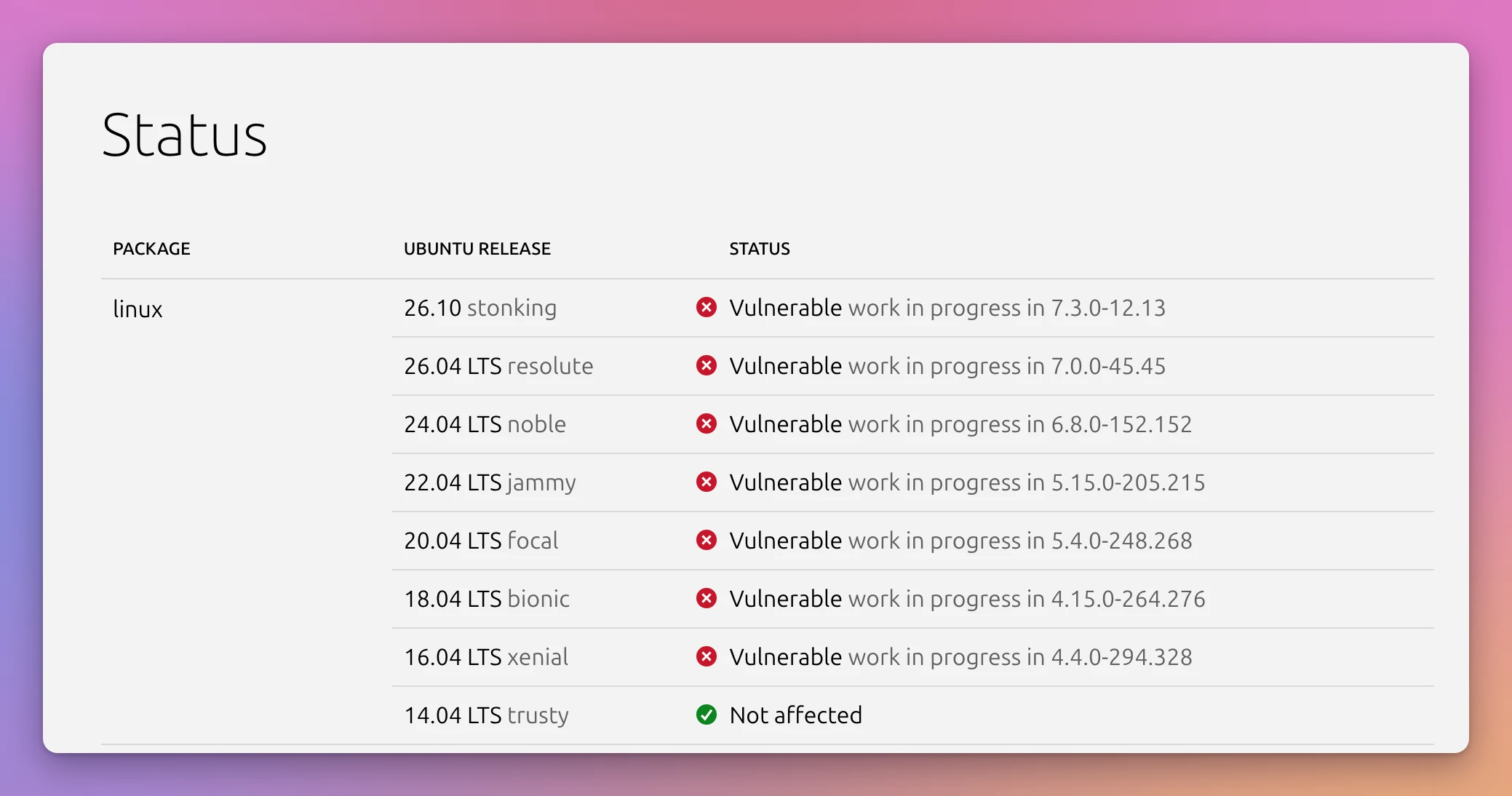
I don’t think Canonical is being careless here. The way Ubuntu ships kernel fixes was designed for a world where serious kernel bugs were rare, and that world ended this year.
Three kernel bugs, three distros
Here’s how long each distro took to ship a fixed kernel for its current stable release, counting from the day the CVE was published:
| CVE | Published | Debian | Red Hat (RHEL 9/10) | Ubuntu (LTS) |
|---|---|---|---|---|
| CVE-2026-98432, IPv4 TCP use-after-free | Oct 15 | Oct 16 (DSA-6568-1), 1 day | Nov 1, 17 days | Nov 10 (USN-9018-1), 26 days |
| CVE-2026-99288, NoisyTCP | Nov 10 | Nov 13 (DSA-6628-1), 3 days | Nov 23, 13 days | still vulnerable |
| CVE-2026-99312, KVM host escape on AMD | Nov 18 | Nov 22 (DSA-6652-1), 4 days | still affected | still vulnerable |
NoisyTCP’s CVE went out on November 10 under the usual distro embargo, and the full write-up followed on November 16. Debian shipped its fix three days before the write-up.
Debian isn’t perfect either. Debian 12 bookworm still lists the KVM bug as vulnerable, and Red Hat hasn’t fixed it in RHEL 9 or 10. In the HN thread, someone paying for Red Hat’s top tier says their teams on free Debian and Alma patch days sooner. Every distro that does careful, slow, certified kernel updates looks bad right now, Ubuntu just the most.
Freeze and backport
Ubuntu picks a kernel version when an LTS comes out and keeps it for the whole life of the release. Ubuntu 26.04 runs a 7.0.0 kernel, and 24.04 still runs 6.8.0. When upstream fixes a bug, Canonical takes the patch, backports it onto that frozen kernel, and builds it for every variant: generic, HWE, AWS, Azure, GCP, Oracle, NVIDIA, low latency, real time, Raspberry Pi and more. The status table on each Ubuntu kernel CVE page lists 169 kernel packages.
Each build then goes through what Canonical calls certification. Their CVE-2026-98432 post says they test fixes “on more than 2,000 certified servers and devices” before releasing them.
Debian 13 does something else. It follows the upstream longterm kernel, 6.12, which Greg Kroah-Hartman and the stable team maintain on kernel.org. When a fix lands there, Debian packages the next stable release. Hanno’s post puts the two side by side: a recent Ubuntu LTS reports 7.0.0-44, a Debian stable system reports 6.12.118+deb13.
The kernel developers have an opinion on this. The kernel’s CVE documentation says:
As always, it is best to take all released kernel changes, as they are tested together in a unified whole by many community members, and not as individual cherry-picked changes.
Why it used to work
For a long time, freeze and backport was a good deal. Your server never got a new kernel with new behavior by surprise. Drivers kept working, and an LTS could run for five or ten years without a major upgrade. A handful of serious kernel bugs a year meant a handful of careful backports a year, and a few weeks of testing before release was a fair price for not breaking thousands of machines.
That’s why so many of us picked Ubuntu for servers in the first place. You knew when the next LTS was coming, you knew how long it was supported, and the updates didn’t break things.
What changed
The bugs stopped being rare. Canonical says so itself, in the post announcing its new kernel release strategy:
The recent explosion in the volume of CVEs is fueled by artificial intelligence: large language models (LLMs) and specialized AI agents have transformed bug discovery from a manual, time-intensive process into a highly automated engine.
The kernel also became its own CVE authority and now assigns CVEs to thousands of bug fixes. And the bugs that matter come with exploits much faster. In October, OpenAI’s kernel research run produced 948 distinct local root exploits for a stock Linux desktop, at about $1,279 each (I went through the numbers in how to protect your app from AI-powered attacks).
When dozens of fixes a week need to be backported by hand to a frozen kernel, and each one waits for a certification cycle, you end up with weeks between the upstream fix and the update on your server, even if the process is exactly as good as it was five years ago.
PHP and the rest of userland
The kernel gets the headlines, but most of what an attacker reaches on a server is userland: PHP, Node.js, nginx, OpenSSL, and the thousands of libraries under them.
Here Ubuntu did well on the big one. When PHP shipped the fixes for the two remote code execution bugs that people called php2shell (CVE-2026-109618 and CVE-2026-109619) on October 21, both distros had packages out the same day:
| Upstream PHP | Ubuntu 24.04 LTS | Debian 13 | |
|---|---|---|---|
| Fix released | Oct 21 | Oct 21 (USN-8948-1) | Oct 21 (DSA-6574-1) |
| Fixed package | 8.3.36 / 8.4.27 | 8.3.6-0ubuntu0.24.04.13 | 8.4.27-1~deb13u1 |
Look at the version numbers, though. Debian 13 shipped PHP’s own fixed release, 8.4.27. Ubuntu 24.04 still runs 8.3.6, with the security patches backported into it, while upstream PHP 8.3 is at 8.3.36. It’s the same freeze-and-backport model as the kernel. It works for a famous bug with a whole security team on it, and it gets harder for everything else.
And there’s a lot of everything else. Ubuntu’s ESM page says the Universe repository holds over 36,000 packages per release, including “toolchains and libraries like Java, Php, GO, Python and others”, and that Canonical’s security maintenance for all of Universe comes with Ubuntu Pro. Pro is free for personal use on up to five machines, but on a server without it, the login message tells you how many security updates are waiting behind ESM Apps.
Debian isn’t immune either. Debian 13 ships Node.js 20, which upstream has already marked end of life, and Debian backports fixes into it on its own (I covered this in the Droplet migration post). Any distro that freezes a runtime for years has to keep patching a version its authors stopped looking at.
For the software that faces the internet, I’d favor running a version its upstream still supports, from a source that follows upstream releases: Debian’s own security updates when they track upstream, or the project’s official packages or container images. And whatever your app pulls from npm or Composer was never your distro’s job in the first place.
What I’d favor instead
I’m not saying “drop Ubuntu”. Canonical is already changing things: kernel updates move from a 4-week cycle (2 weeks for security) to a 2-week cycle that publishes every week, release candidates go to the -proposed pocket for people who want them before certification, and they aim to publish workarounds within 24 to 48 hours of disclosure.
I think the direction should be a bit different, though, for any distro.
Follow the upstream stable kernels
Take the whole longterm release, as the kernel developers recommend, instead of cherry-picking fixes onto a kernel nobody else runs. That’s what got Debian’s fixes out in days.
Ship smaller updates more often
A monthly patch day doesn’t fit a world where a published fix can be turned into an exploit quickly. On Debian or Ubuntu, unattended-upgrades can install security updates and reboot the machine at a quiet hour. These two lines go in /etc/apt/apt.conf.d/50unattended-upgrades:
Unattended-Upgrade::Automatic-Reboot "true";
Unattended-Upgrade::Automatic-Reboot-Time "04:00";
Kernel updates only take effect after a reboot, so without the first line the new kernel sits on disk while the old one keeps running.
Expose less
NoisyTCP can be triggered against a plain TCP listener, like nginx or SSH with default settings, on any server with more than one receive queue. A server with no public ports doesn’t care how long the distro takes. That’s the setup I described in securing a VPS with Tailscale and Cloudflare Tunnel: SSH over the tailnet, web traffic through an outbound tunnel, nothing listening on the public address. The Linux Server & Self-Hosting Handbook covers the basics of running your own box.
If you’re picking a distro for a new server today, look at how its kernel follows upstream and how fast its last few critical fixes shipped, next to how many years of support it promises. The Ubuntu, Debian and Red Hat trackers are public, so comparing them for a recent CVE takes a few minutes.
Want me to talk about your product? You can sponsor this site.
Related posts about security: