How to turn a word list into printable flashcards on a Mac
By Flavio
A list pasted into a TextEdit table lands in one cell, so the free way is to type every word again. Flashcard PDF Printer takes the list as it is: one card per line, the word on the front and its translation on the back.
You have a vocabulary list in a document or a note: a word, a comma and its translation on each line. You want every line as a paper card, with the word on the front and the translation on the back.
The free way is a table in TextEdit, the writing app that comes with the Mac. It means typing the list again, one word per cell. The shorter way is Flashcard PDF Printer, a Mac app I built. You copy the list, paste it, and each line becomes a card.
How do you do it for free in TextEdit?
Here are twelve kitchen words in English and Italian, on a test Mac with macOS 15 Sequoia. The list was made up for this example.
- Open TextEdit and choose Format > Table…. A small Table window opens next to the new table, which started here with 2 rows and 3 columns.
- In the Table window, click the arrows until Rows says 12 and Columns says 2.
- Click the first cell and type the first word. Press Tab, type its translation, press Tab again, and go on until the last line, chair and la sedia.
- Press Command-A to select everything. Click the size box in the toolbar, type 36 and press Return. Then click the second of the four alignment buttons to center the words.
- Press Command-P to print.
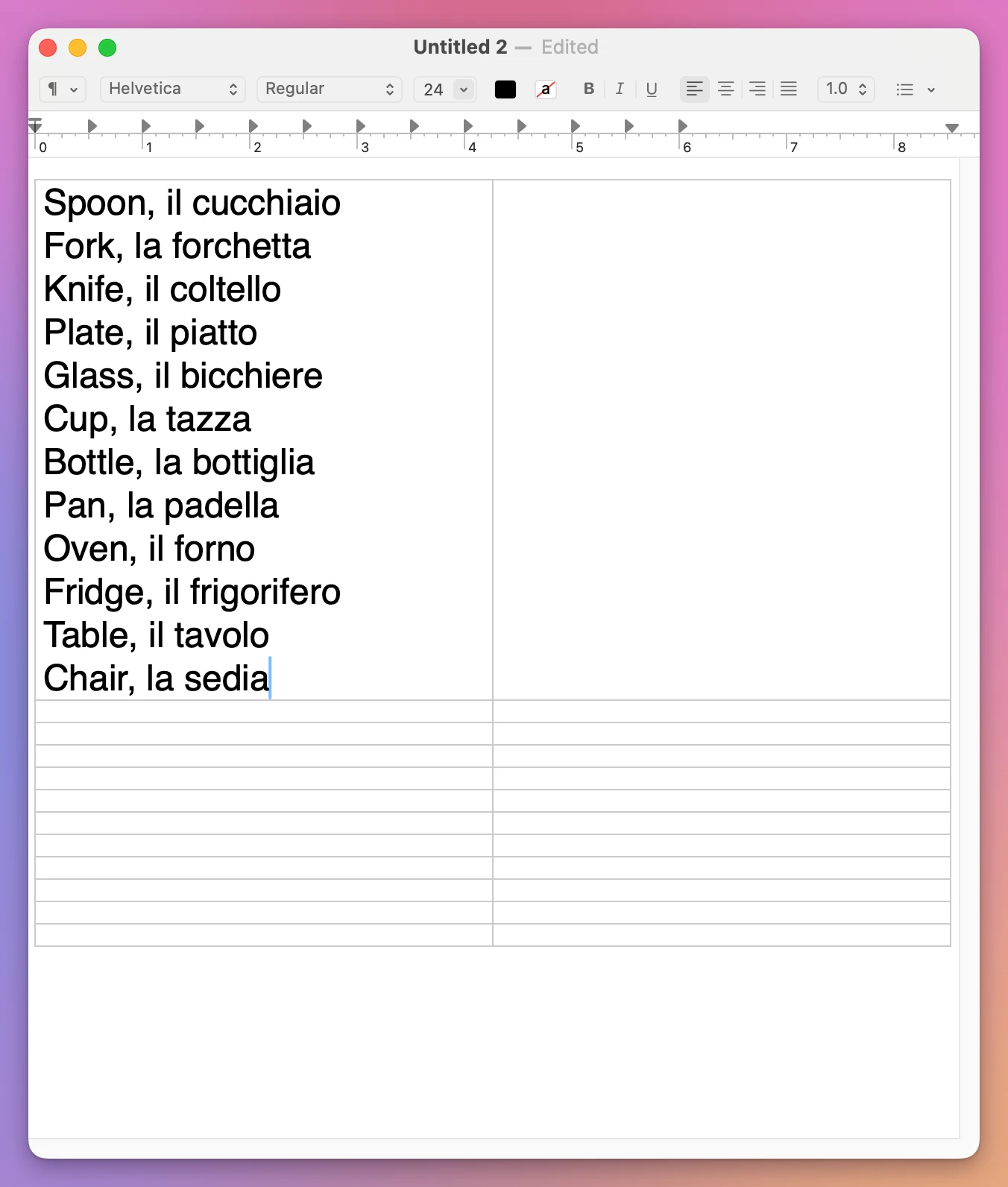
Pasting doesn’t spare you step 3. With the list copied and the first cell clicked, Command-V put all twelve lines in that one cell and left the other rows empty.
What does the free way cost?
Typing the twelve lines again took 181 letters and spaces, 23 presses of Tab and 16 clicks. TextEdit also gave every translation a capital letter, so il cucchiaio became Il cucchiaio.
The cards are small. Each one is as tall as its line of text, so at size 36 a card measured about 81 × 15 mm, and the twelve rows took up about two thirds of the height of a US Letter page.
Each translation sits next to its word, on the same side of the paper. That’s a sheet to fold and glue, as in How to make two-sided flashcards with a printer that prints one side.
| A table in TextEdit | Flashcard PDF Printer | |
|---|---|---|
| The list you already have | Typed again, one word per cell | Pasted as it is |
| Work for 12 lines | 181 letters and spaces, 23 presses of Tab, 16 clicks | 3 keyboard shortcuts and 2 clicks |
| Capital letters | Added to every translation | Left as they are in the list |
| Size of a card | About 81 × 15 mm at size 36 | 98 × 87 mm with 6 cards on a US Letter sheet |
How do you do it with Flashcard PDF Printer?
Flashcard PDF Printer turns a list into sheets of cards. It costs $20, paid once.
- In the document with your list, press Command-A to select it and Command-C to copy it.
- Open the app and click Paste a List.
- Press Command-V. The list appears in the box.
- Check the lines under the box, then click Add 12 Cards.
Under the box, the Paste a list window says how many cards the list makes and shows the first three. Here it said “12 cards found.”, then Spoon with il cucchiaio, Fork with la forchetta, and Knife with il coltello. If a word and its translation got mixed up, you see it before anything is added.
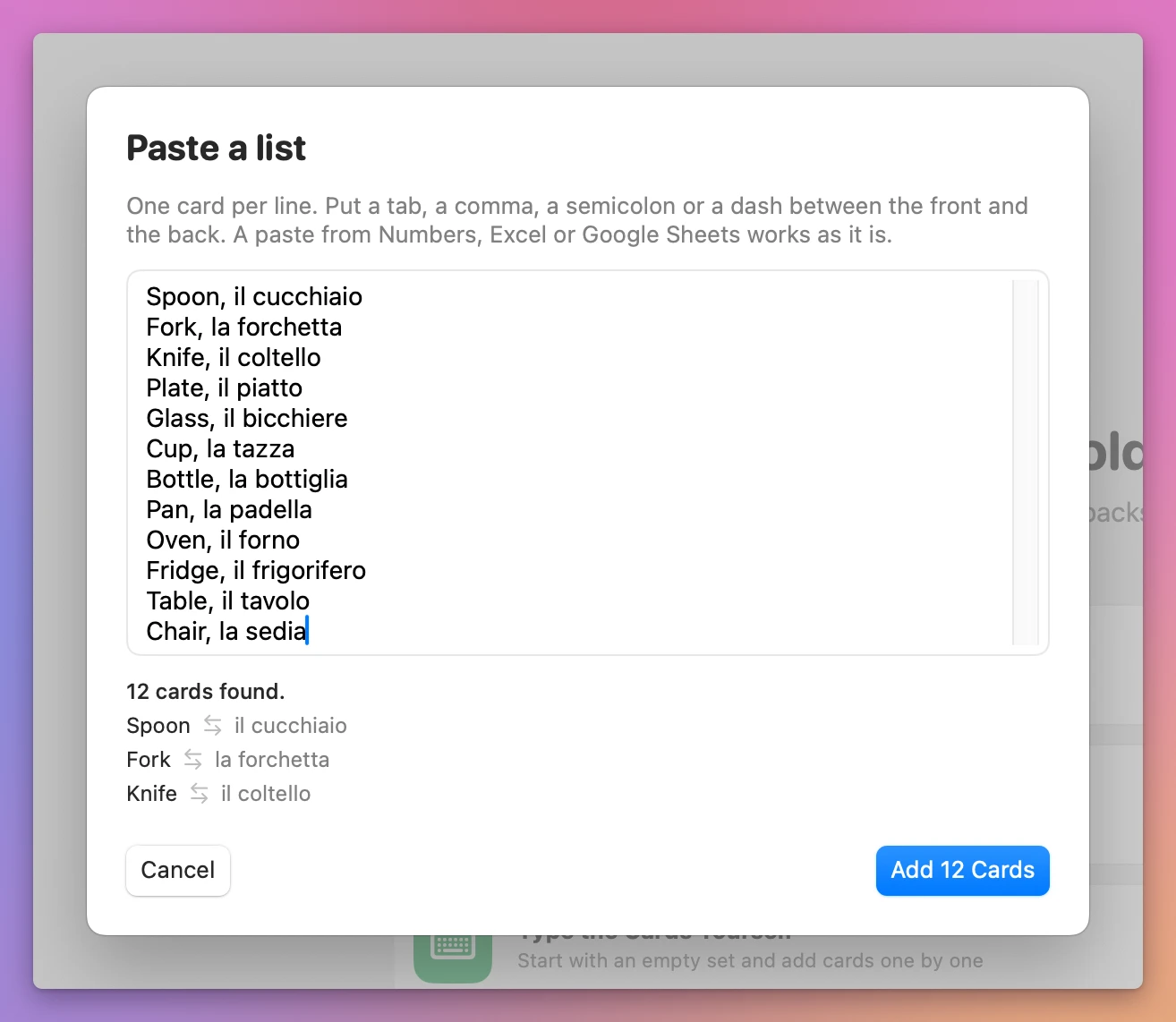
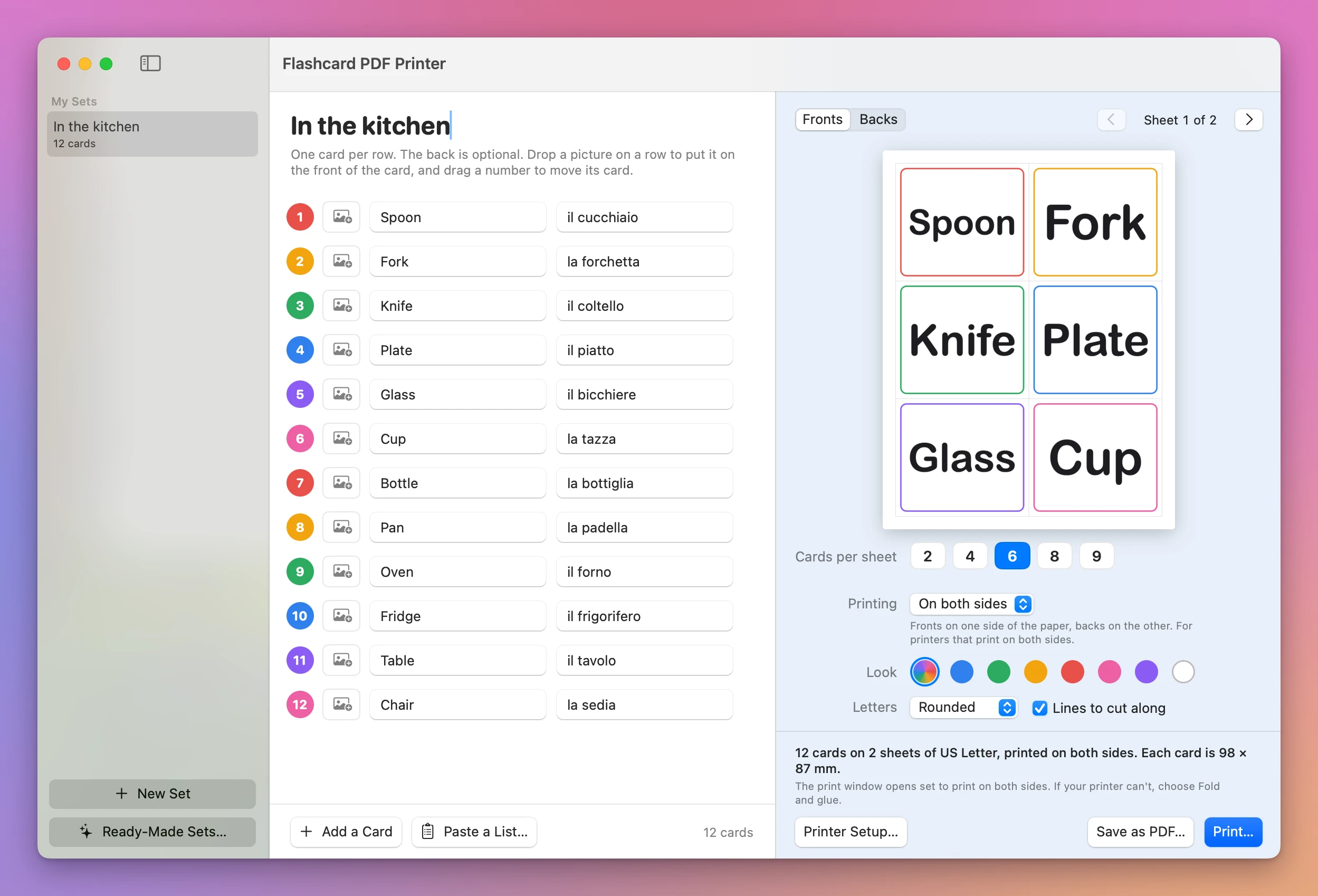
The set opens as New set, with one row for each line and the first sheet on the right. Click the name, press Command-A, type a new one (here, In the kitchen) and press Return.
The set opened with 8 cards per sheet. With 6 chosen next to Cards per sheet, the line under the sheet said “12 cards on 2 sheets of US Letter, printed on both sides. Each card is 98 × 87 mm.”
Does the list need commas?
The window names four choices: “Put a tab, a comma, a semicolon or a dash between the front and the back.” Here’s what the same twelve lines made with each one.
| Between the two words | What the window found |
|---|---|
| A comma | 12 cards, each with a back |
| A tab | 12 cards, each with a back |
| A semicolon | 12 cards, each with a back |
| A dash with a space on each side | 12 cards, each with a back |
| A dash with no spaces | 12 cards with no back, and the whole line on the front |
Use the same one on every line. In a list of commas, the one line written as Fork - la forchetta became a front with no back.
A second comma is kept. Fork, la forchetta, le forchette made a card with “la forchetta, le forchette” on the back.
Numbers and bullets at the start of the lines were dropped, and so were empty lines between them.
What happens to a line with one word?
It becomes a card with a front and no back. In the Paste a list window the count was still “12 cards found.”, and Fork stood on its line with nothing next to it.
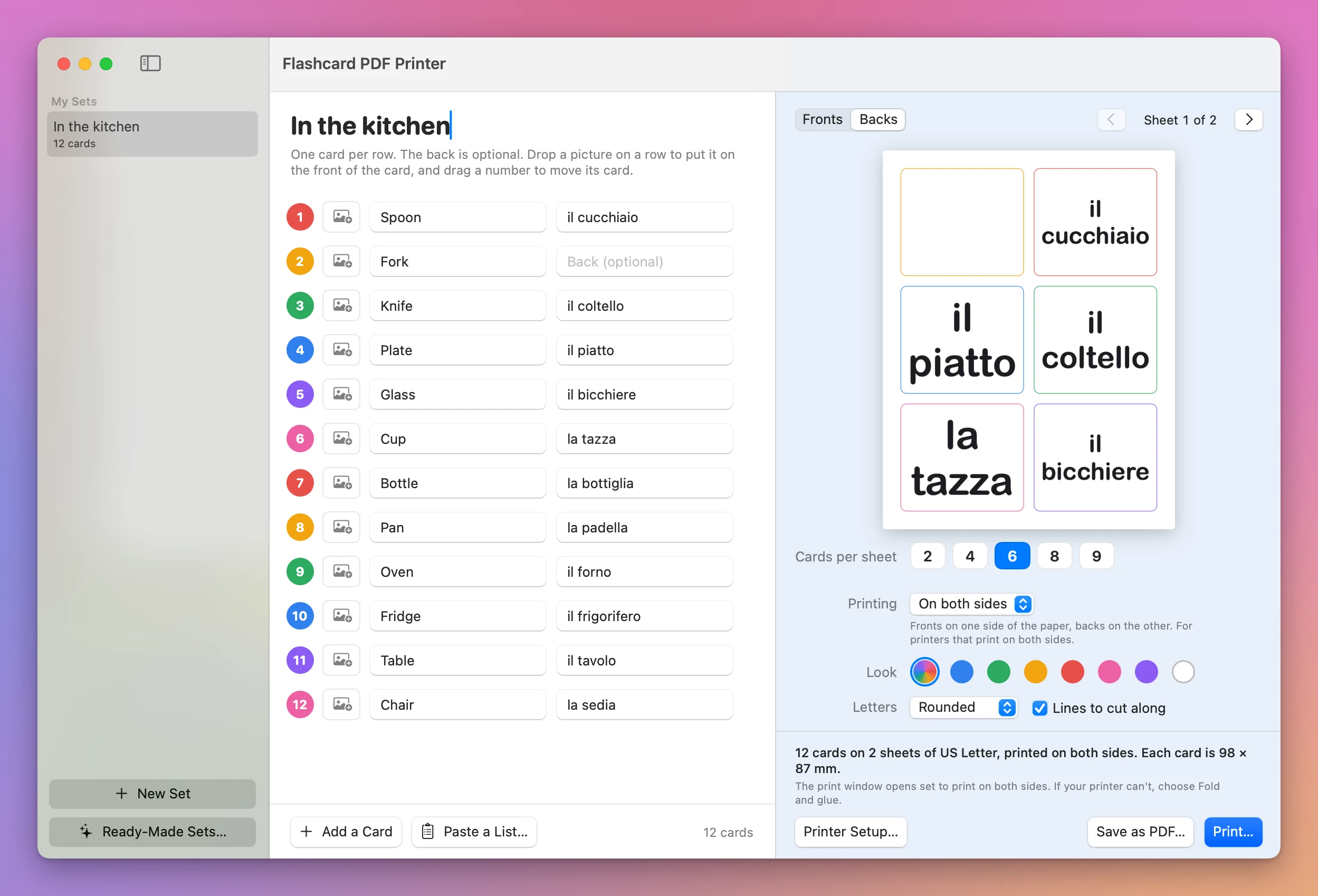
In the set, the second box of that row is empty and says “Back (optional)”. Click Backs above the sheet and the card behind Fork is an empty frame. Click the box and type the missing word, and the sheet shows it.
A list with one word on every line makes fronts only. The Fronts and Backs buttons go away, and the app says “No card has a back yet, so only the fronts will print.”
How do you print them, or save a PDF?
Save as PDF… asks for a name and a place. Here it suggested the set’s name and the Documents folder.
Opened in Preview, the file has four US Letter pages: six fronts, their backs, the other six fronts, their backs. On the second page la forchetta is on the left and il cucchiaio on the right, because the sheet gets turned over.
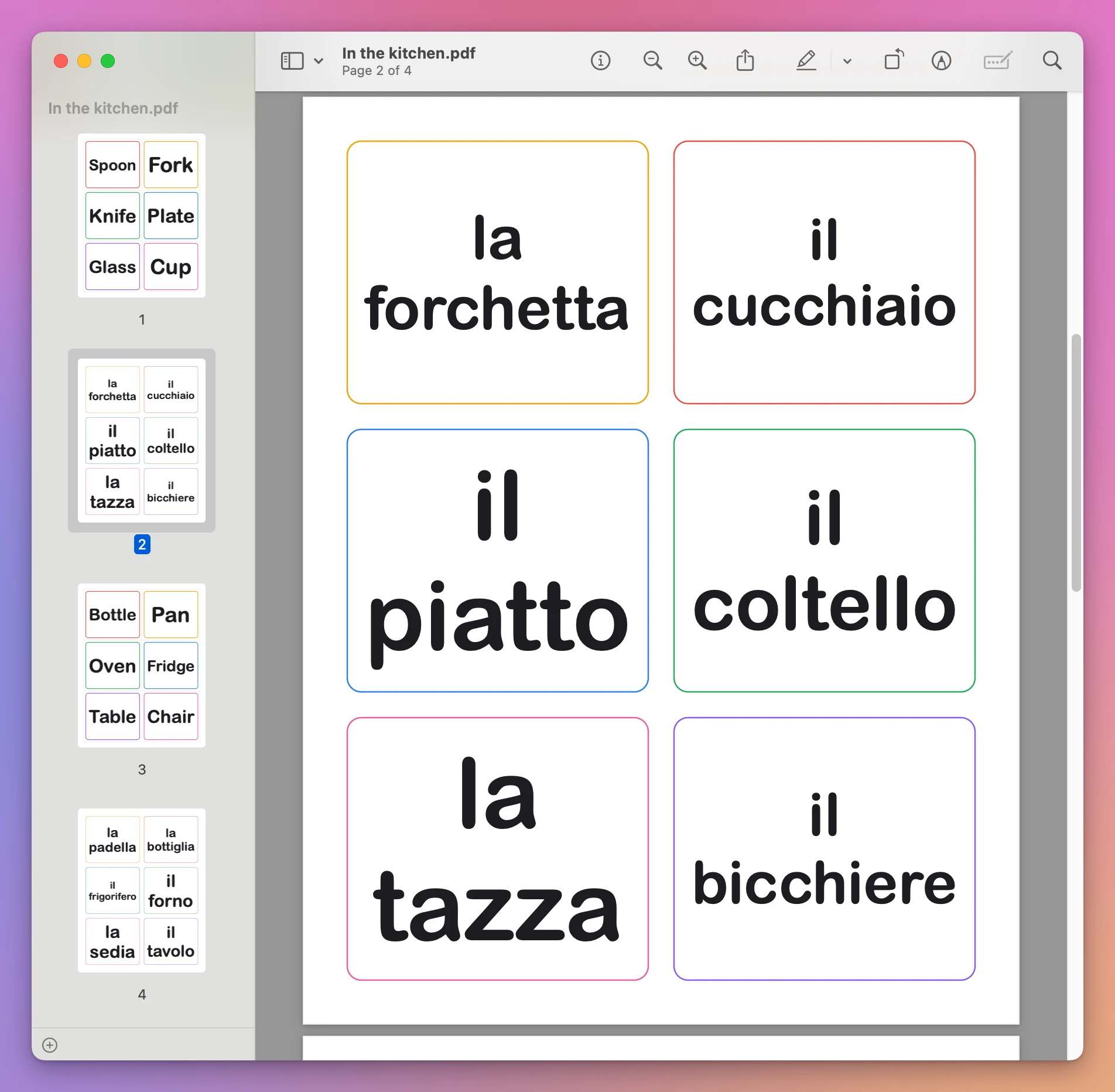
Print… is the button next to it. The test Mac has no printer, so nothing was printed here. How to print double-sided flashcards on a Mac covers printing on both sides and the test sheet for your printer.
Get Flashcard PDF Printer
Turn a list of words into paper flashcards. Type or paste the fronts and the backs, or start from a ready-made set, pick how many cards go on a sheet, and print them or save a PDF. Each back is printed exactly behind its front.
See Flashcard PDF Printer → · Read the docs · $20. See the app page for tax details.
Want me to talk about your product? You can sponsor this site.