Pre-train and observe
Checkpoints and sampling
Compare saved model states with fixed prompts and sampling controls instead of choosing isolated outputs after the fact.
A checkpoint is a saved model state at one training step. It lets you resume and compare progress.
Choose an early, middle, and later checkpoint. Run the three baseline prompts against each one.
Keep temperature, top-k, top-p, min-p, maximum tokens, and random seed fixed where the app exposes them.
These controls act on one next-token distribution:
- temperature changes how sharp or flat the distribution is
- top-k keeps at most the highest-scoring
kcandidates - top-p keeps the smallest high-probability set reaching a probability mass
- min-p removes candidates too weak relative to the best candidate
- the random seed controls reproducible draws when supported
Do not change every filter at once. For the baseline, choose one documented preset and keep it fixed.
Run at least two sampling conditions for a useful contrast:
- deterministic or very low-randomness output for checkpoint comparison
- one moderate-randomness preset with three fixed seeds
One lucky stochastic sample is not evidence that a checkpoint improved.
Save every output, including weak ones. Add the checkpoint and settings above each sample in your notebook.
Look for changes in spelling, sentence closure, repetition, topic continuity, and similarity to the dataset.
If a later checkpoint produces worse text, check validation loss and several seeds before deciding it regressed. The latest weights are not automatically the best weights.
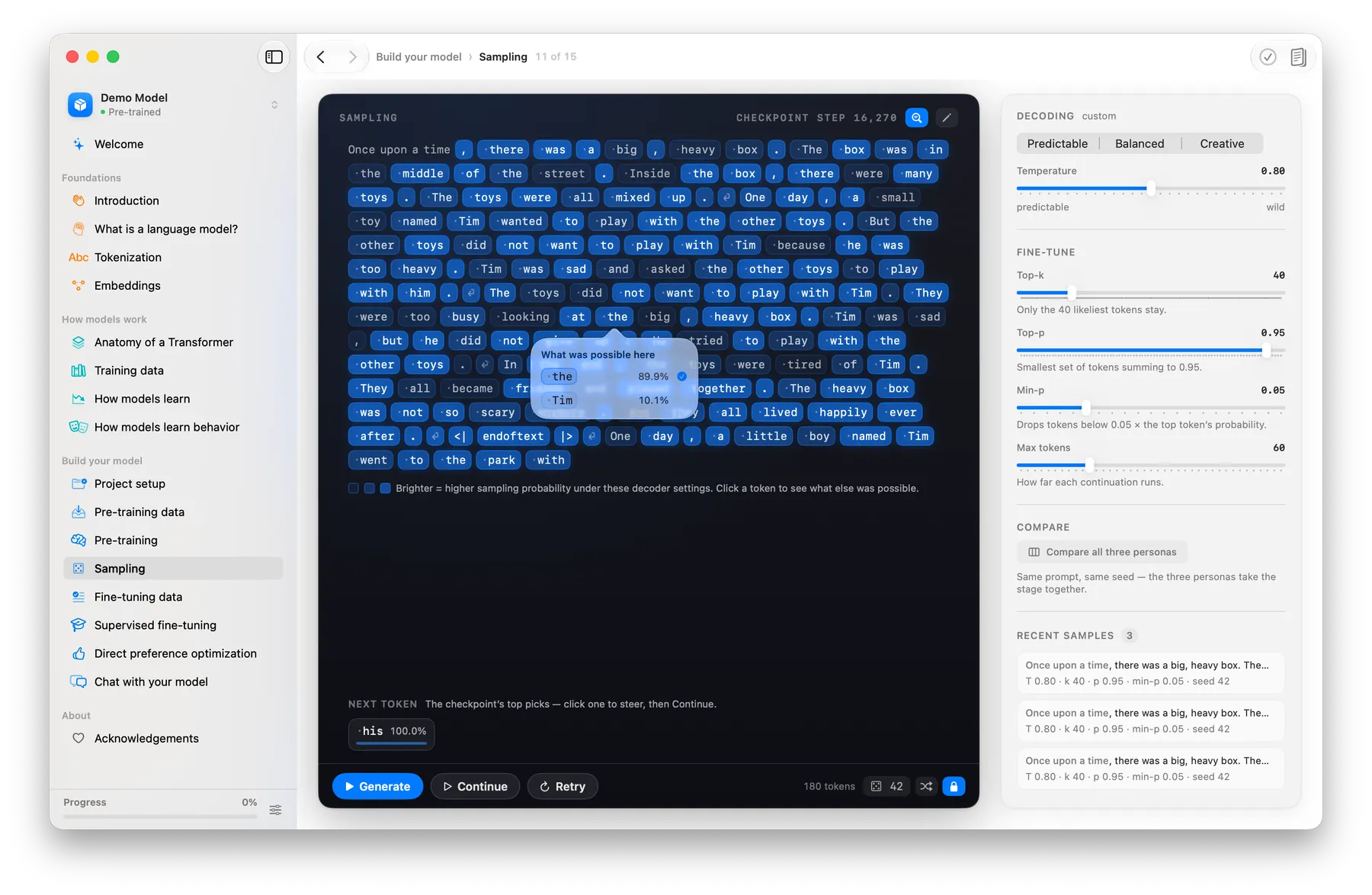
My advice is to label each sample block like this: checkpoint 6,000 | temp 0.8 | seed 42 | prompt: fox. Without that header, you will mix up outputs a week later.
Run seed 42 twice on the same checkpoint. If the two outputs differ while you thought sampling was deterministic, your settings were not actually fixed. Fix that before you score checkpoints.
Lesson completed