Reverting a file to a previous version, on a Mac
By Flavio Copes
Learn how to revert a file to a previous version on a Mac using the File, Revert To menu and the Time Machine view to browse and restore older saves.
To revert a file to a previous version on a Mac, open it and use the File → Revert To menu. Apps like Pages, Numbers, TextEdit and many other document-based apps keep old versions of your files automatically, and let you browse and restore them.
I found this out the hard way. I was working on a Pages document one morning when I decided to save and immediately quit the application.
The moment I did it, I realized I did a mistake: the previous evening I did some edits to the cover of the document, removing the background image, and I forgot to revert.
I tried reopening it and of course cmd-Z didn’t work to revert the change - it could only work before quitting Pages.
Then I thought about using the backup which I usually do.
But then, I also found out a feature which I never used in many years of owning a Mac.
Some applications, including Pages, Numbers, and many other non-Apple apps that use documents, like MindNode, have a File -> Revert To menu.
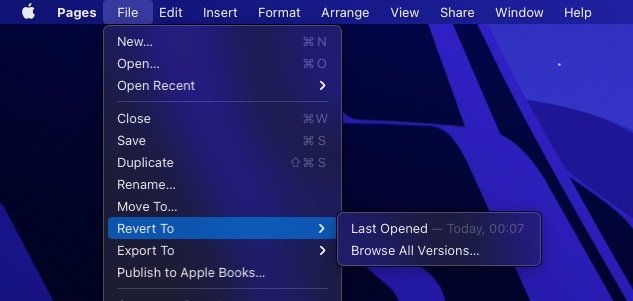
You can immediately revert to the latest saved version, but you can click “Browse All Versions…” to enter into the Time Machine view of that file:

From here you can go back to any previous saved version.
How does this work?
macOS saves a version of the document every time you save it, and periodically while you work on it. This happens in every app that adopts Apple’s document system, which is why the menu shows up in third-party apps too.
Despite the interface looking exactly like Time Machine, this has nothing to do with your backup drive. Versions are stored in a hidden database on the same disk as the document. That’s good news, because it works even with no backup configured. And bad news too: if the disk dies, the versions die with it. Keep backups anyway.
Keeping both versions
If you’re not sure you want to throw away the current state, hold the Option key while in the versions browser: the Restore button becomes “Restore a Copy”. You get the old version as a new document, and the current one stays untouched.
One limitation to know about: versions don’t travel with the file. If you copy the document to a USB drive or send it to someone, only the latest version goes with it.
Also, apps that don’t use Apple’s document system don’t have this menu at all. Microsoft Word, for example, relies on its own recovery features instead.
Want me to talk about your product? You can sponsor this site.
Related posts about mac: